The short version
In 1899 an American cryptanalyst named Elizabeth Wells Gallup said she had found a hidden message inside the First Folio of Shakespeare — not in the words, but in the shapes of the letters. Two slightly different italic typefaces, alternating, spelling out a binary code devised by Sir Francis Bacon.
Almost everyone has considered this as nonsense for a century. Almost nobody has measured it. That is the whole of what this project does.
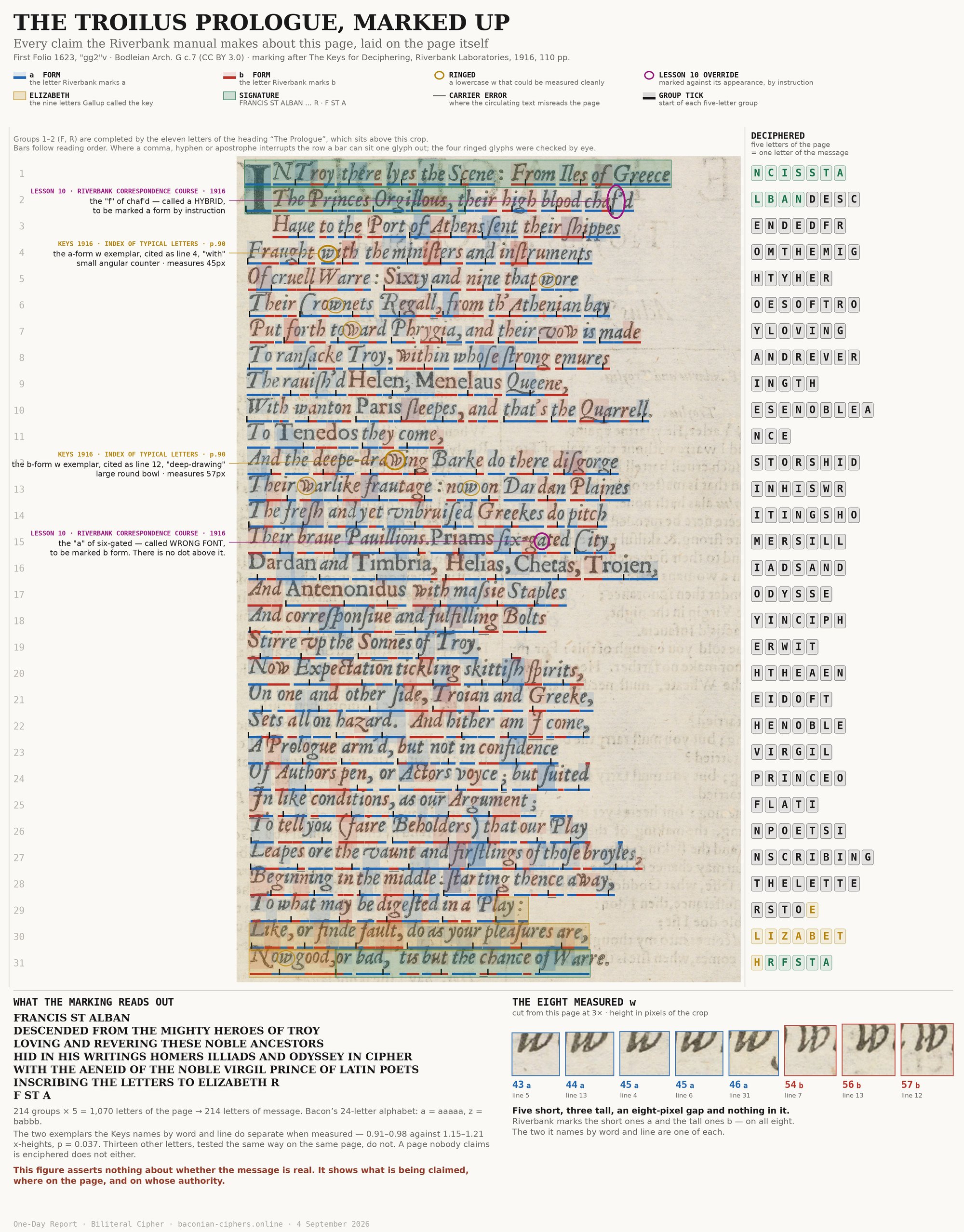
Can I just see the claim, on the page?
The figure above is the whole of it in one picture. Every letter of the Prologue carries a bar in the colour of the form Riverbank assigns it. Every fifth letter starts a new group, and each group is one letter of the message running down the right-hand margin — FRANCIS ST ALBAN at the top, ELIZABETH R and the signature at the foot.
Two things are worth looking at closely. The gold rings mark the eight w clean enough to measure; the two the 1916 index names by word and line are ringed heavily, and the strip at the bottom shows all eight cut from the page — five with a small angular counter, three with a large round bowl, and nothing in between. That much is visible without any statistics.
The magenta rings are the other half of the story. Those two glyphs are the ones a Riverbank lesson instructs the student to mark against what the glyph looks like. A rule that needs exceptions supplied by the teacher is not being read off the page.
Questions
What is the biliteral cipher?
Sir Francis Bacon described it in 1623. Every letter of the alphabet becomes a group of five symbols, each symbol either an a or a b — binary code, three centuries before binary code.
The two symbols need not be letters at all. They can be two founts of type so similar that a reader notices nothing. Print an innocent passage in an alternating mixture of the two, and the shapes of the letters carry a second message underneath the first.
So what is actually being tested here?
Not whether Bacon wrote Shakespeare. Something much narrower: is the italic type on these pages one fount, or two? That is a question about metal, ink and paper, settled in 1623. The photographs are free and public, and anybody with the same images can check the working or overturn it.
It is the necessary condition. If there is only one fount, the claim dies where no argument can reach it. If there are two, nothing about Bacon follows — but a fact about the book would be established that nobody currently knows.
What was the test, and why does it matter that it failed to kill anything?
Yesterday's measurement found that the sixteen lowercase w on our page fall into two clean groups by height, with an empty gap between them and nothing near the boundary.
The obvious objection — and it was ours, not a critic's — is that this might be ordinary printing-house history. The letter w does not exist in Latin. Continental type-founders under-supplied it, and English printers made up the shortfall from wherever they could. A case holding ws of two different origins would produce exactly this split, with no cipher anywhere near it.
That objection makes a prediction: the split should appear wherever italic w appears in this book. So we went and looked at another page.
The Prologue to Henry V — same book, same fount, same shop, an italic Prologue in verse, and not one of the five passages Riverbank ever claimed. Fourteen ws. They are all the same height. One single group, no gap, and every one of them sits in the range of the short form from our page. Not one is tall.
So the split does not appear wherever w appears. Something about our page still needs explaining.
Does that mean the cipher is real?
No — and today also produced the worst evidence against it yet.
Tracking down an old newspaper story led to a book from 1913 by Gertrude Horsford Fiske, containing alphabets drawn by Gallup herself. Its plate of our passage is taken from the Second Folio of 1632 — a completely different printing, set nine years later by different workmen from different type.
And a folder of 1916 worksheets in the New York Public Library shows a Riverbank student deciphering the same passage from the Third Folio of 1664, and getting a different message, signed with different initials.
A cipher carried by the shapes of letters cannot survive being re-set in new type. Three printings, three readings, and at most one of them can be reading the type. That is not our argument — it is theirs, assembled from their own books.
Then why keep measuring?
Because the two findings are about different things, and conflating them would be the easy mistake.
The three-printings problem is about what Gallup and Riverbank were doing. It is close to fatal to their decipherments.
The height measurement is about what is on one leaf of one book. Two groups of w with an empty gap, on a page where a control page shows one group, is a fact about that leaf whatever anyone in 1899 or 1916 believed. It might have a thoroughly boring explanation — and there is a good candidate, below — but it is not disposed of by showing that the people who first pointed at the page were unreliable.
What is the boring explanation you have not ruled out?
Our page is a cancel — a leaf printed separately and later, to replace one already set. Troilus and Cressida gave the Folio's printers more trouble than any other play: begun, abandoned over a rights dispute, resumed, its opening pages reprinted, and much of it set by an apprentice whose work was so error-prone that his superiors had almost everything he touched proof-read.
A leaf produced in those circumstances might easily have been set from a case holding sorts of two origins. That would give a split on this page and no split on a normally-produced page — which is exactly what we observe.
It is testable. The rest of that cancel is three more pages, and nobody has ever claimed a cipher on any of them. They are next.
What would change your mind?
Written down in advance and unchanged:
- If the rest of the cancel shows the same split, it is a printing accident and the cipher reading of it is finished.
- If more control pages turn out to split after all, the Henry V result was a fluke of small numbers.
- If the other letters never separate, the claim is dead regardless — Riverbank's own key gives paired forms for the whole alphabet, and today fourteen letters were tested and none of them separated.
A negative is published in the same terms as a positive. That was decided before any data was looked at.
Isn't a fourteen-letter failure already fatal?
It is the strongest thing against the cipher on the measurement side, and it is stated in full in the technical section rather than buried.
Every letter with enough examples to test was tested — fifty-six separate tests on shape, height, width and position. Nothing survived. The letter e, with ninety-nine examples, came back further from significant than a coin-toss would predict.
So whatever is happening with w, it is not happening across the alphabet. A cipher needs the whole alphabet. A type-case accident needs only one letter — and w is precisely the letter an English printer was most likely to have in mixed sorts.
Who is doing this and why?
Walter Wilkinson, Worland, Wyoming. The overall project encompasses Orville Owen's Word Cipher; this is its sister strand.
The reason it has merit is that the question has stayed arguable for 127 years purely because nobody measured it — and until about six years ago, nobody easily could. The photographs went online free. The statistical machinery got built for another purpose entirely. Both halves now exist, and no one had put them together.
The wider project lives at New Gorhambury, which collects the sources, the experiments and the Word Cipher work. Experiment One is this report's direct ancestor. Worth knowing before you read it: that page argues a conclusion. These reports deliberately do not. The difference is the point of publishing them daily.
External documents
Every source relied on, with what it is and where the original lives. All are free and public.
Technical colophon
Everything below is reproducible from public data and was produced on 4 September 2026. One page image was downloaded once; every measurement after that ran offline.
Harvest
Text block of the Prologue leaf fetched once at native resolution (region 1400,1350,2260,3820 of a 5412 × 7216 page). Ink components per verse line by Gaussian blur σ1.6, Otsu, small-object removal; components aligned to the TEI characters by dynamic programming over moves 1:1, 1:2, 1:3, 2:1, 3:1 with relative advance widths.
glyph records            1,061
exact one-component-to-one-character      794   (74.8%)
lowercase w surviving the exact filter      8   (all 8 boxes confirmed by eye)
The instrument validates against an independent run
Different crop, different threshold, different segmentation, different aligner from the 3 September pipeline — and the same numbers:
| source | a-form heights (px) | b-form heights (px) |
|---|---|---|
| this harvest | 43 44 45 45 46 | 54 56 57 |
| 3 Sep run | 43 45 45 45 45 46 48 | 54 57 57 57 57 58 58 59 |
Gap 8 px here against 6 px there. Permutation p = 0.0185 at n = 5/3.
⚑ The negative control — Henry V, and it returns null
Canvas 424, fol. h1r, page 69: The Life of Henry the Fift, "Enter Prologue." An italic Prologue in verse, same book, same fount — and not one of the five passages Riverbank plated. No transcription exists, so the w were found by normalised cross-correlation against the eight verified Troilus exemplars and confirmed from a contact sheet that displayed no heights, so the operator could not select on the measured variable.
CONTROL  Henry V Prologue          n = 14
  heights          27 28 28 28 28 28 28 29 29 29 29 30 30 30
  as x-heights     0.87 .90 .90 .90 .90 .90 .90 .94 .94 .94 .94 .97 .97 .97
  largest gap      1 px = 0.03 x-heights        unimodality p = 0.16

CLAIMED  Troilus Prologue           n = 8
  a-form           0.91 0.94 0.96 0.96 0.98  x-heights
  b-form           1.15 1.19 1.21            x-heights
  gap              8 px = 0.17 x-heights      unimodality p = 0.037
Every control w falls inside the Troilus a-form range; none falls in the b-form range.
⚑ Fourteen letters as simultaneous controls — all null
Every letter with at least six of each form under Riverbank's labels: composite-difference on size-normalised glyphs (5,000 permutations), plus height, width and rise above line centre (20,000 permutations each). Fifty-six tests.
letters tested   e t r i n a s o d l h u c g
nominal hits     shape 1 of 14   (expected by chance 0.7)
                 scalars 3 of 42 (expected by chance 2.1)
e (72a / 27b, 99 glyphs)   shape p = 0.78, observed separation BELOW the null mean
Nothing survives correction for multiplicity. w was named on 2 September, before any of this, so it is a confirmatory test on a pre-registered target with fourteen simultaneous controls. The target separates; the controls do not.
The digraph test — a single sort cannot be two forms
A ligature is one piece of type: one sort, one case position, therefore one bit — but two letter-positions in the message. The two letters must share a bit. If the marking gives them different bits, the marking is not reading type.
41 candidate ligature sites (fi st ct sh si ss sp sl)
  same bit   23  (56%)        differing  18  (44%)        binomial p = 0.27
At chance. The marking shows no sign of being constrained by what a piece of type can physically do. Seven sites fuse into a single ink component and three of those carry contradictory bits — but a fused ink component is not proof of a single sort, since touching types fuse too, so that half is suggestive only.
v21's carrier is machine-read
Aligned letter by letter against the Bodleian TEI: 30 mismatches, 2.8%, and their pattern is diagnostic — cruell→eruell, come→eome, chance→ehance (c/e); your→yonr, corresponsiue→corresponsine (u/n); Regall→Regaii (ll/ii). OCR confusions, not reading errors. The a/b marks are positionally intact at 1,070; the letter identities are wrong in thirty places. The TEI corrects them at no cost.
⚑ Three printings, three readings
| source | edition worked | outcome |
|---|---|---|
| Fiske / Gallup, 1913 | Second Folio, 1632 | plate 92; the key alphabets are plates 8–10 |
| Riverbank Keys, 1916 | First Folio, 1623 | the Classifier plate; the marking behind v21 |
| E. S. Smith, June 1916 | Third Folio, 1664 | a full signed message — "By such skill…" — W. R. |
Fiske's Prologue plate is identifiable as the 1632 setting from its readings alone: Scæne for Scene, Jmmures for emures, Barkes doe for Barke do, massy for massie, and modernised Have / ravish'd / brave / up.
A cipher carried by letterforms cannot survive resetting. These three were set years apart by different compositors from different cases. At most one can be reading type — and the same operation on all three produced a message every time.
Riverbank sold this as a correspondence course
Ten photographs of New York Public Library, Manuscripts and Archives, Box 15 — Elizebeth Smith's own worksheets, June 1916, each signed in her maiden name. Two are not decipherments but teaching material: "LESSON 10 / INSTRUCTION SHEET 10", on our Prologue, and its second page, which sets out the terms.
"the plates must be returned to the Riverbank Laboratories in the addressed
 envelope provided for the purpose … If for any reason the student cares to
 retain any of the photographs, an additional charge of 25c each will be made"

recorded labour, in her hand:   Actors' Names  8 hours    Catalogue 14 hours
                                Digges poem   12 hours    I. M. poem 3.5 hours each of two
Lesson 10 states the dot rule as a parity rule — "an even number of dots does not change the form of the letter" — and sets polarity letter by letter against the other passages. It then says:
"In line 15, the 'a' in 'six-gated' is wrong font and should be marked b form;
 the 'f' of chaf'd, line 2, is a hybrid, whose marking is a form."
Both glyphs were fetched and examined. There is no dot above the a in six-gated — a hypothesis worth testing, and the answer is no. The word applied to the other is hybrid: a glyph belonging to neither class. A binary cipher cannot have a third category, and the teaching material resolves it by instruction rather than by rule.
The standing non-cipher explanation, now precise
Hinman, The Printing and Proof-Reading of the First Folio (Oxford, 1963), vol. I pp. 204–225, arrived by interlibrary loan. Compositor E — an apprentice — set pre-cancellation Troilus and its first page. Hinman: "Compositor E was expected to make a great many mistakes … practically everything that E set … was proof-read." He also excepts two pages of the present Troilus text from the A/B attribution, and his notation is compositor-plus-case, with mid-forme case switches demonstrable and rare. Our leaf is a cancel from the most disrupted stretch of the book's production.
Publication
hosting   GitHub Pages, branch main, served from the repository root
build     none — hand-written HTML, no framework, no generator
DNS       Namecheap BasicDNS · A @ 185.199.108/109/110/111.153 · www CNAME fb-decipherer.github.io.
TLS       Let's Encrypt, issued and renewed automatically
tracking  none — no analytics, no cookies, no third-party scripts
cost      one domain registration a year, and nothing else
About a dollar a year. Nothing here depends on a service that can withdraw it, raise a price, or fold.
Next, in order
- The rest of the cancel — "gg3"v, "gg4"r, "gg4"v. If the split is a property of the cancel, it appears there, and no cipher is claimed on any of them.
- More control pages, to take the control sample past n ≈ 50.
- Gallup's 1913 alphabets against the 1916 Keys descriptions of the same letters. If the stated criteria changed in three years, they were not being read off fixed objects.
Standards this series holds itself to
- Predictions and falsifiers are written down before the data is looked at.
- Only open, re-fetchable data. No privileged access, no unique artefact.
- A determinate procedure. The 1916 method depends on "the practised eye"; that is precisely what cannot be audited.
- Necessary-condition framing with every result: two founts is not a message.
- Negative controls must return null. A pipeline that finds structure everywhere has found nothing.
- The null gets published in the same terms as a positive.
- Where the work cuts against the claim, it is said here first.