The short version
In 1899 an American cryptanalyst named Elizabeth Wells Gallup said she had found a hidden message inside the First Folio of Shakespeare — not in the words, but in the shapes of the letters. Two slightly different italic typefaces, alternating, spelling out a binary code devised by Sir Francis Bacon.
In 1916 her employers at Riverbank Laboratories published a manual showing, letter by letter, what they held the two forms to look like. Photographs of individual letters, each on a ruled grid, with a written description beside it. That book has sat on the internet, free, for years.
Questions
What is the biliteral cipher?
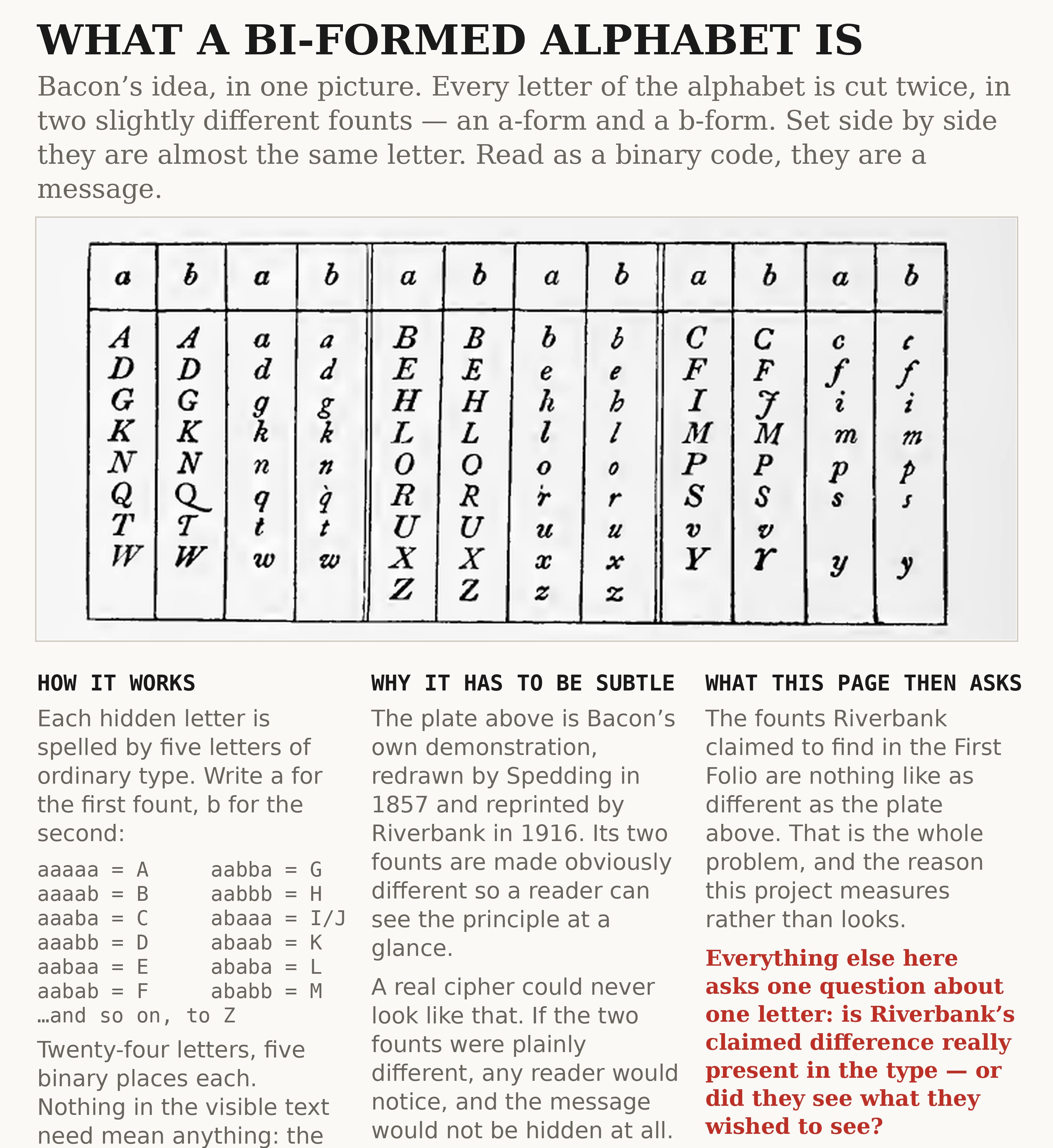
Sir Francis Bacon described it in 1623. Every letter of the alphabet becomes a group of five symbols, each symbol either an a or a b — binary code, three centuries before binary code.
The two symbols need not be letters at all. They can be two founts of type so similar that a reader notices nothing. Print an innocent passage in an alternating mixture of the two, and the shapes of the letters carry a second message underneath the first.
What was done today, in plain terms?
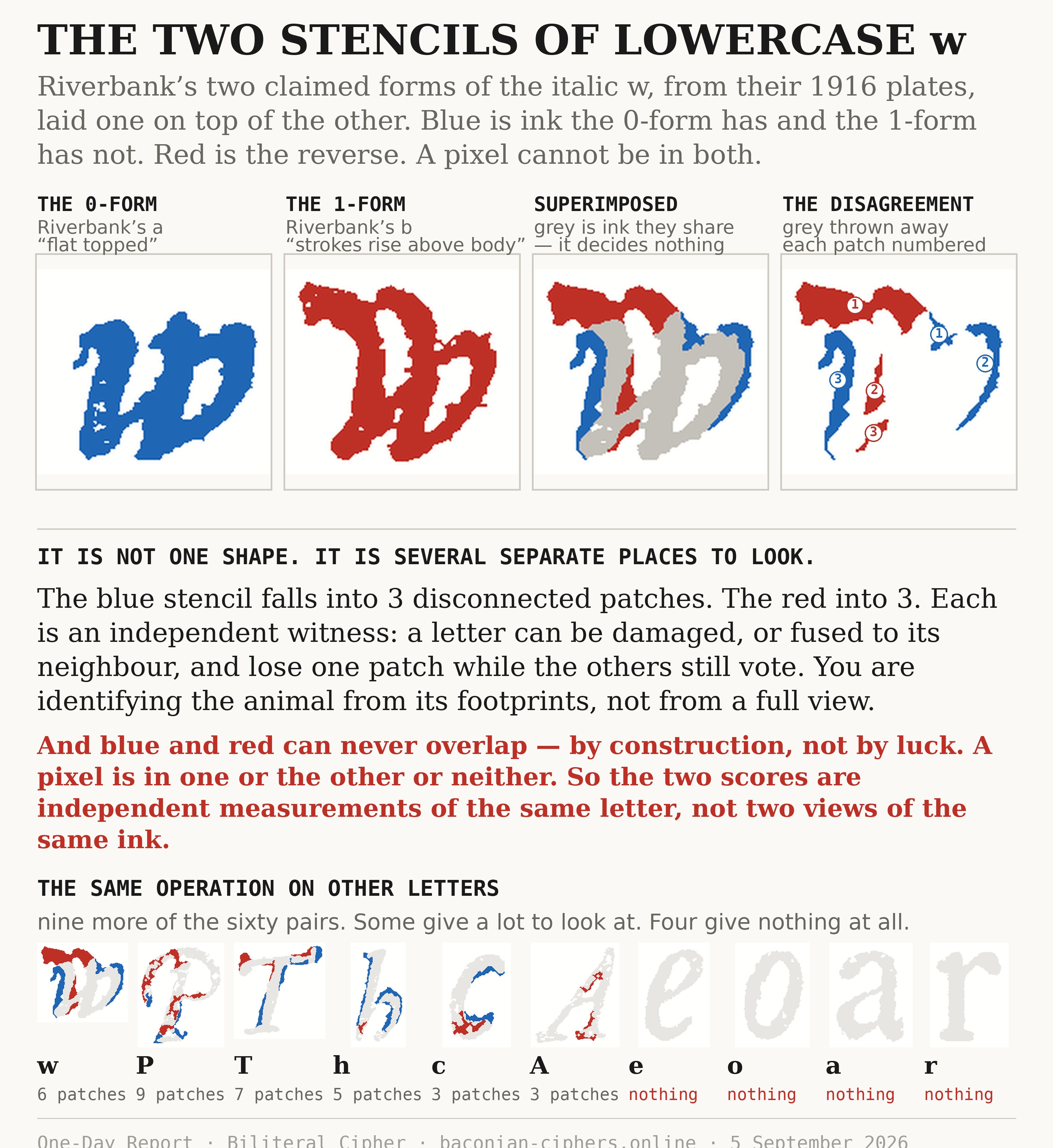
Riverbank's manual contains photographs of each letter in both of its claimed forms. Take one such pair, lay the two photographs on top of each other, and ask where they disagree.
Most of the letter is the same in both — that grey area tells you nothing, so throw it away. What is left is two stencils: the ink only the first form has, and the ink only the second has. By construction they cannot overlap.
Then take a real letter off the Folio page, lay it on the stencils, and ask which one it fills. That is the whole test. No judgment, no eye, no interpretation.
Why does it matter that the stencils come from their book?
Because every previous version of this test derived the two shapes from the page itself, and a fair critic could answer: you found a split and then named it.
This time the two shapes come from a book printed in 1916 and never touch the Folio until the moment of scoring. So do the scale and the alignment. Nothing about the instrument knows anything about our page.
There was one thing left to fix: the plates and the page are photographed at different sizes, so a conversion factor is needed. It was set from six letters — a e o d n s — chosen precisely because Riverbank's own plates show no difference at all between their two forms of those letters. A ruler cut from letters that carry no signal cannot smuggle any in.
And the result?
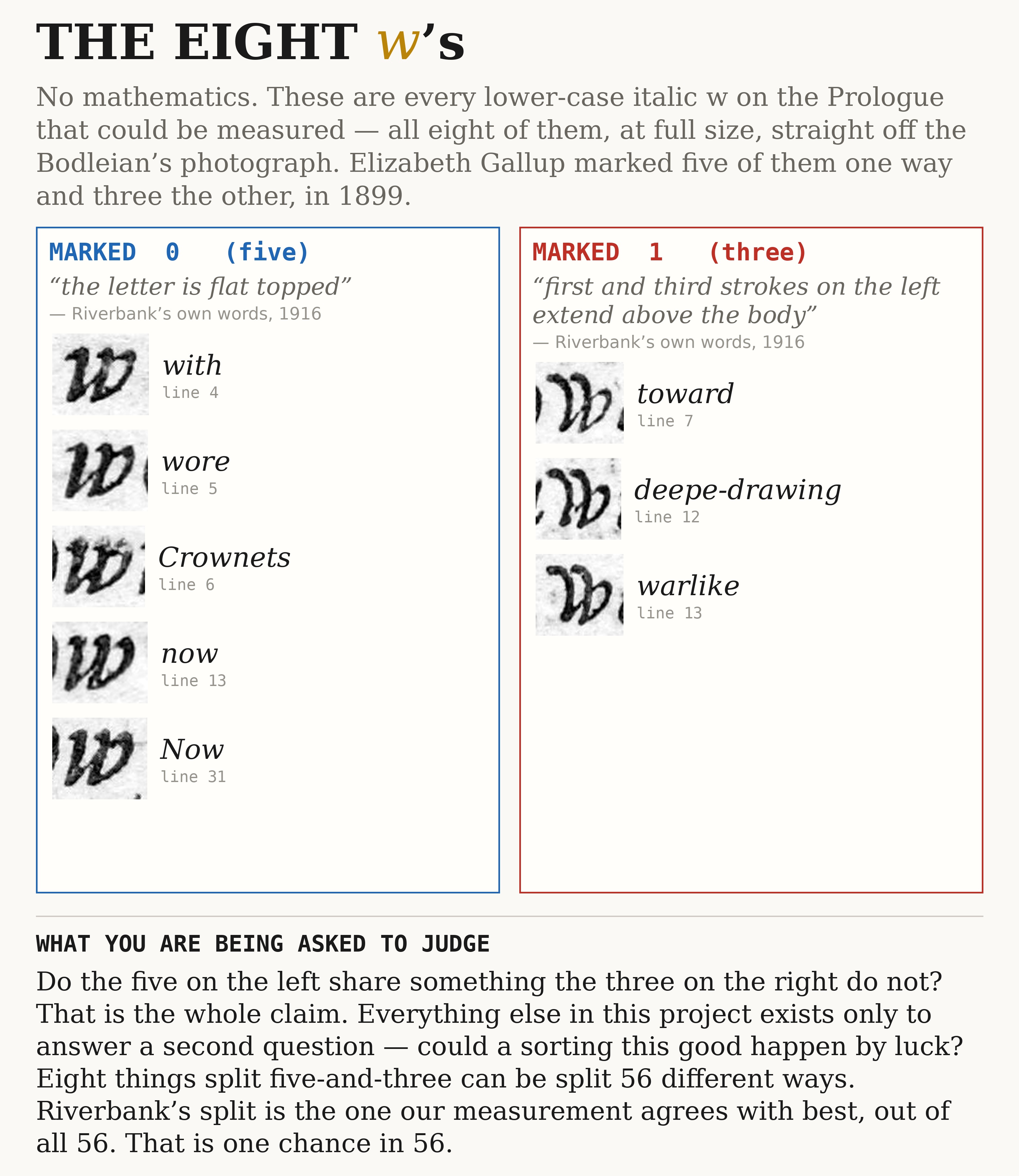
The five w Riverbank marks a all scored positive. The three it marks b all scored negative. No overlap, no letter near the boundary.
There are 56 ways those eight letters could be divided five-and-three. Riverbank's is the best one. Not among the best — the best.
Five other letters on the same page had enough clean examples to test the same way. The strongest of them managed about a quarter of w's separation.
You keep finding things against the claim. Is this one for it?
Yes. It is the strongest result this project has produced, and it should be said plainly rather than buried under qualifications.
What it establishes is narrow but real: on this page, the letter w comes in two shapes, those shapes match the ones a 1916 manual described in words, and a mechanical procedure can tell them apart without any human judgment. None of that was known yesterday.
What did their own alphabet give away?
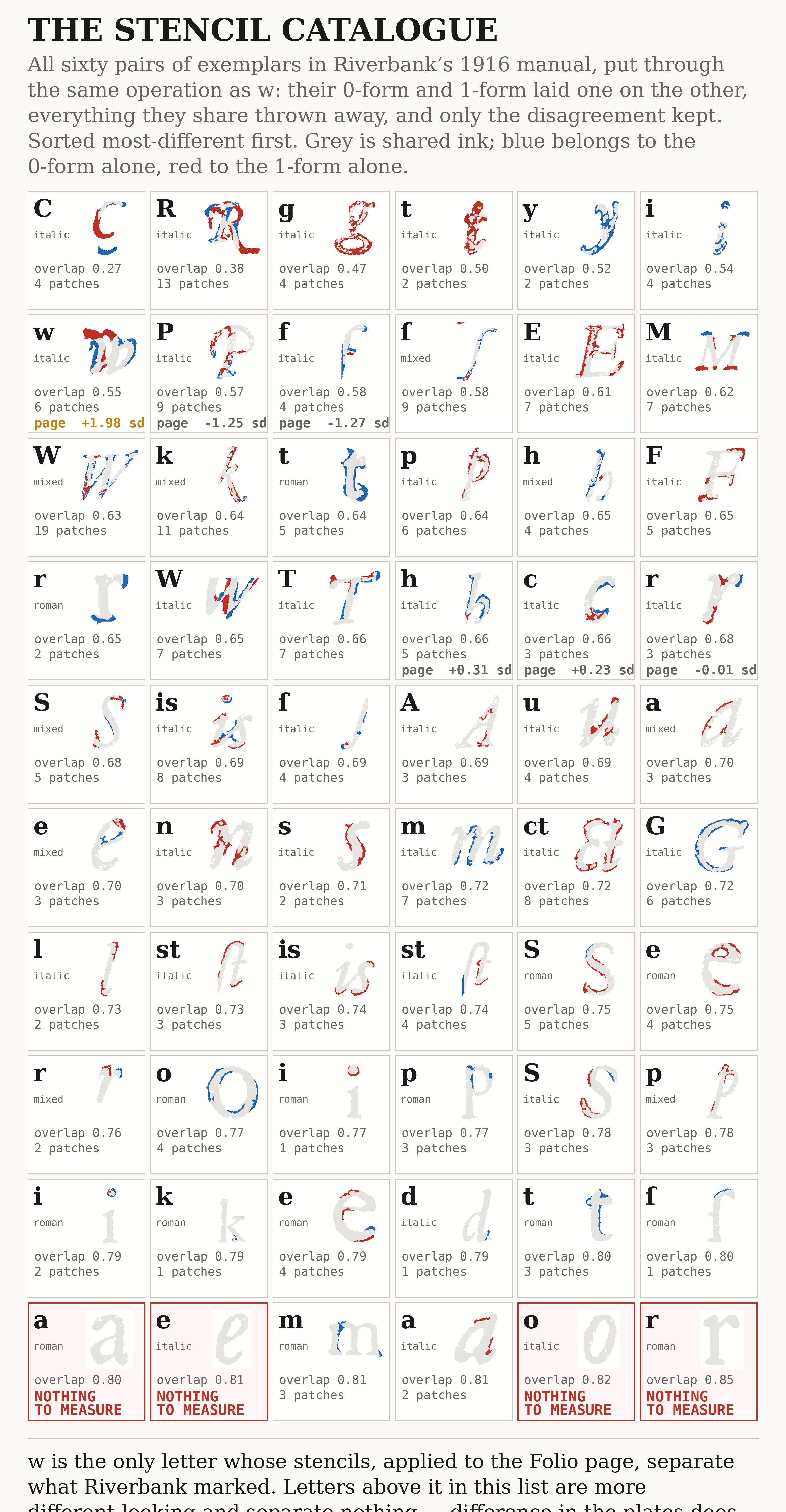
Something they cannot have intended. Sixty pairs of exemplars came out of the manual. For four of the commonest letters in English — e, o, a and r — there is no difference to find. Lay their two photographs on top of each other and almost nothing is left over. Their own plates supply nothing to tell the forms apart.
That is their evidence agreeing, from the opposite direction, with the fifty-six measurements this project ran last week and published as null. We looked at the page and found nothing for most letters. Their book shows there was nothing to find.
So is the cipher real?
Not established, and today does not establish it. Two founts is not a message. A cipher needs the whole alphabet, and most of the alphabet still shows nothing — on the page and, it now turns out, in their own plates.
What has changed is the instrument. Until today, testing Riverbank's claim meant reconstructing what they might have meant. Now their stated forms can be measured directly, at any scale, on any page, by anyone with the same free files.
What happens next?
Eight letters is a small foundation. The same procedure now runs unchanged on more letters and more pages, and there are about 900,000 letters in the Folio, every one of them free to fetch.
Three things are queued. Whether the split survives on the rest of the cancelled leaf, which nobody claims is enciphered. Whether other letters separate once there are hundreds of examples rather than eight. And whether the whole alphabet, scored this way, produces anything but noise.
Any of those can kill it. That is the point of running them.
Who is doing this and why?
Walter Wilkinson, Worland, Wyoming. The sister strand is the Word Cipher work published alongside this.
The reason it has merit is that the question has stayed arguable for 127 years purely because nobody measured it — and until about six years ago, nobody easily could. The photographs went online free. The statistical machinery got built for another purpose entirely. Both halves now exist, and no one had put them together.
The wider project lives at New Gorhambury. Worth knowing before you read it: those pages argue a conclusion. These reports deliberately do not.
External documents
Every source relied on, with what it is and where the original lives. All are free and public.
Technical colophon
Everything below was produced on 5 September 2026 from two free files: the Bodleian's image service, and The Keys for Deciphering (Riverbank Laboratories, 1916) on archive.org. Every number can be re-derived from them.
Extraction of the exemplar plates
Pages 43–78 of the Keys carry photographs of individual letters in both claimed forms, each mounted on a ruled grid. Rendered at 300 dpi; frames located by local variance; the inner glyph panel taken as the bright region that contains ink — a first pass that took the largest bright region instead missed six panels.
pages rendered                    36
gridded frames detected          132
panels with usable ink           128
pairs (a above, b below)          63     3 dropped as cross-letter
pairs measured                    60
⚑ The XOR, with the reference never scaled
Both halves of a pair come from the same plate at the same magnification, so they are brought together by translation only. Scaling would have destroyed the height difference, which for w is the whole signal. Best alignment searched over ±24 px in both axes.
overlap = shared ink / total ink, at best alignment
median across the 60 pairs        0.699
lowercase w (italic)              0.547     7th most different of 60
usable stencils on BOTH sides       25 of 60
stencil on one side only            31
NO discriminating region at all      4   ->  e, o (italic) and a, r (roman)
⚑ Calibration, built so it cannot leak
One global page→plate scale factor for the whole page, estimated from six letters — a e o d n s — chosen because their plates show no discriminating region. A ruler cut from letters that carry no signal cannot introduce any.
a 2.043   e 2.052   o 2.021   d 2.110   n 2.054   s 1.936
GLOBAL SCALE = 2.047      spread 1.94 - 2.11
Six independent letters agreeing to within 9% is itself a check that the 1916 plates and the Bodleian crop are commensurable at all.
⚑ Scoring the page
Every clean glyph of a testable letter, scaled by that one factor, registered to the canonical pair by translation, and scored as (ink falling in the a-only stencil) − (ink falling in the b-only stencil). Riverbank's a/b marking is used only to group the scores afterwards — never to build the stencils, the scale, or the alignment.
letter   n   (a / b)     mean-a    mean-b    separation
w        8   (5 / 3)    +0.5802   -0.6518    +2.06 sd
h       28  (16 /12)    -0.3541   -0.5647    +0.61 sd
P        8   (5 / 3)    -0.1930   -0.2585    +0.50 sd
c       18   (8 /10)    -0.4068   -0.5703    +0.48 sd
r       64  (45 /19)    +0.0160   +0.0003    +0.04 sd
f        9   (6 / 3)    +0.0248   +0.0164    +0.03 sd
Two of these six no longer stand. P is struck twice over — it swings 2.42 sd between fitting methods, and its 1-form exemplar was cut from this very page (see below). f is struck once, for reversing sign under a better fit. The table is left as first computed so the corrections can be checked against it.
Per-glyph values for w:
marked a   +0.582  +0.521  +0.511  +0.606  +0.681
marked b   -0.680  -0.606  -0.670
Complete separation. Every a positive, every b negative, nothing near zero.
The permutation test, exhaustive
At n = 8 with a 5/3 split there are only 56 possible labellings, so no sampling is needed — every one was computed.
observed separation        2.057 sd
best of all 56 splits      2.057     <- Riverbank's labelling IS the best split
median of all 56          -0.127
splits at least as good        1
p = 1/56 = 0.0179   (the floor at this sample size)
⚑ The registration stress test
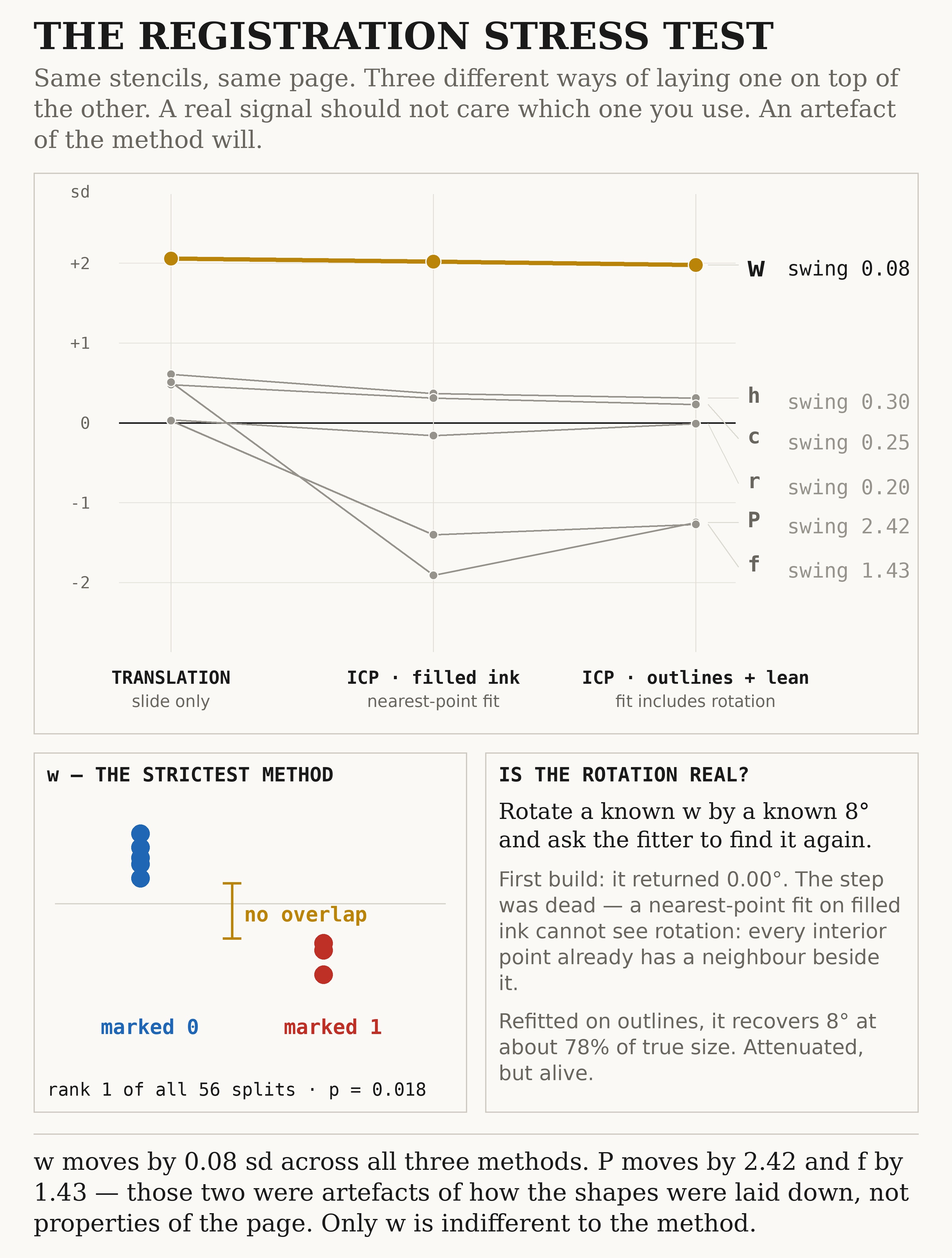
The scoring above lays the stencil on the glyph by sliding it only — an exhaustive search over whole-pixel offsets, keeping the position of greatest overlap. That is the crudest fit available. If a result depends on it, the result is a property of the fitting, not of the page. So the whole measurement was rebuilt twice more and the three answers compared.
The second and third builds use partial Procrustes registration: scipy.linalg.orthogonal_procrustes (the Kabsch rotation, solved by singular-value decomposition of the cross-covariance) driven by a trimmed iterative-closest-point loop, with correspondences from scipy.spatial.cKDTree and the worst 20 per cent of matches discarded each pass. Reflection is forbidden by a determinant check; lean is clamped to ±12°.
A dead step, found by testing it
The second build reported a fitted lean of 0.00° for every glyph. That looked like a finding — plates and page sharing an orientation — so it was tested: take a real w, rotate it by a known 8°, and ask the fitter to recover the angle. It returned 0.00°. The rotation step was inert. Iterative-closest-point on a filled shape cannot see rotation: every interior point already has a neighbour beside it, and the correspondence vectors cancel. Refitted on the shape’s outline, the same test recovers 8° at about 78 per cent of true size — attenuated by the trimming and the clamp, but alive. All figures below are from the corrected build.
letter   slide only   ICP, filled   ICP, outline+lean    swing
w          +2.06        +2.02            +1.98            0.08
h          +0.61        +0.37            +0.31            0.30
c          +0.48        +0.31            +0.23            0.25
r          +0.04        -0.16            -0.01            0.20
f          +0.03        -1.40            -1.27            1.43
P          +0.50        -1.91            -1.25            2.42
Under the strictest of the three, w is still rank 1 of all 56 splits at p = 0.018, still with complete separation:
marked a   +0.405  +0.348  +0.225  +0.497  +0.621
marked b   -0.355  -0.415  -0.632
Not yet done: the per-footprint occupancies are computed blob by blob but still pooled into a single mean before scoring. Matching individual footprints between the two forms — scipy.optimize.linear_sum_assignment over a blob-to-blob cost — is the next version of the scorer and is not in these numbers.
⚑ Where the stencils came from
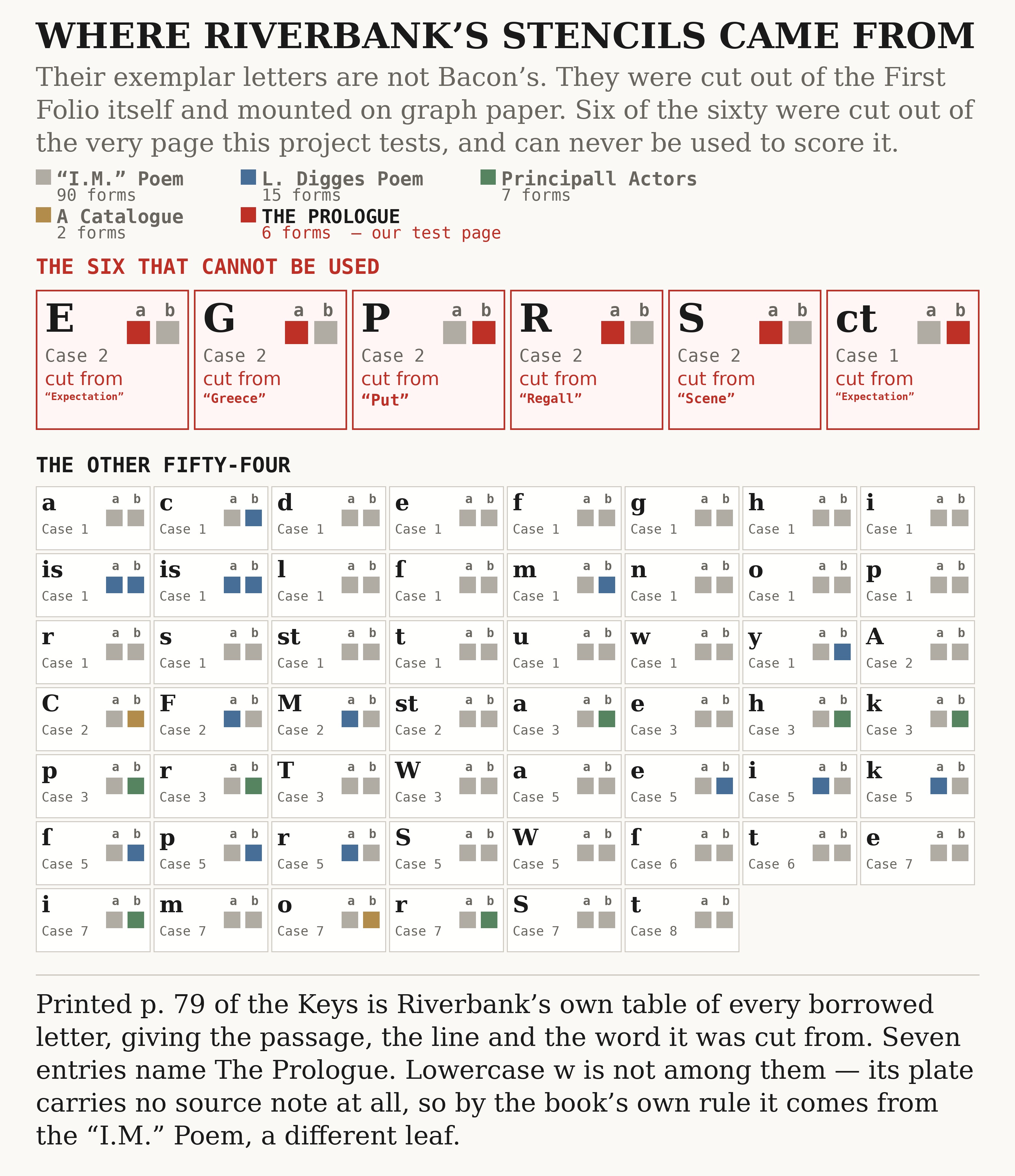
Riverbank’s plates carry two different kinds of alphabet, and the difference matters. At printed p. 16 they reproduce Bacon’s own specimen — captioned, in their words, “Spedding’s modernized illustration of Bacon’s example of the use of a biformed alphabet”, from the 1857 edition. That plate is not what this project uses.
The stencils come instead from pp. 38–72, the Illustrated Description of the Typical Letters: enlarged photographs of letters cut out of the First Folio itself and mounted on cross-section paper. Riverbank say so plainly (p. 11): the pages carrying the “I.M.” and “Digges” poems, “A Catalogue”, “The Prologue” and “The Names of the Principall Actors” were photographed from the original 1623 copy, and the letters cut from those photographs.
⚑ The circularity check
Printed p. 79 of the Keys is a table headed Letters Taken from Other Sources to Supplement the Alphabets and the Classifiers for the “I.M.” Poem — forty-one numbered entries giving letter, case, form, source passage, line and word. Anything absent from it comes from the “I.M.” Poem by default. Seven entries name The Prologue, the page tested here:
  #   letter  case  form   line   word
  9     S       2     a      1    Scene
 10     T       2     b     15    Their
 17     P       2     b      7    Put
 21     E       2     a     20    Expectation
 25     G       2     a      1    Greece
 32     ct      1    bb     20    Expectation
 34     R       2     a      6    Regall
Six of those correspond to stencil pairs held here (S, P, E, G, R, ct; the Case 2 T is not among the extracted plates). All six are struck from any scoring of this page. An exemplar cut from the page cannot be used to test the page.
Lowercase italic w does not appear in the table, and its plate carries no source note — only the descriptions “the letter is flat topped” and “first and third strokes on the left extend above the body”. By the book’s own default rule its exemplars come from the “I.M.” Poem — the short verse “To the memorie of M.W. Shake-speare”, signed I.M. and printed in the preliminaries beneath Leonard Digges’s commendatory poem, on the same leaf. That is a different leaf, and a different forme, from the Troilus Prologue. The w result is not circular. Of the other scored letters, h, r and f are likewise clean; c’s 1-form was borrowed from the “L. Digges” poem, which is not circular here but is not the “I.M.” Poem either.
⚑ The specificity control
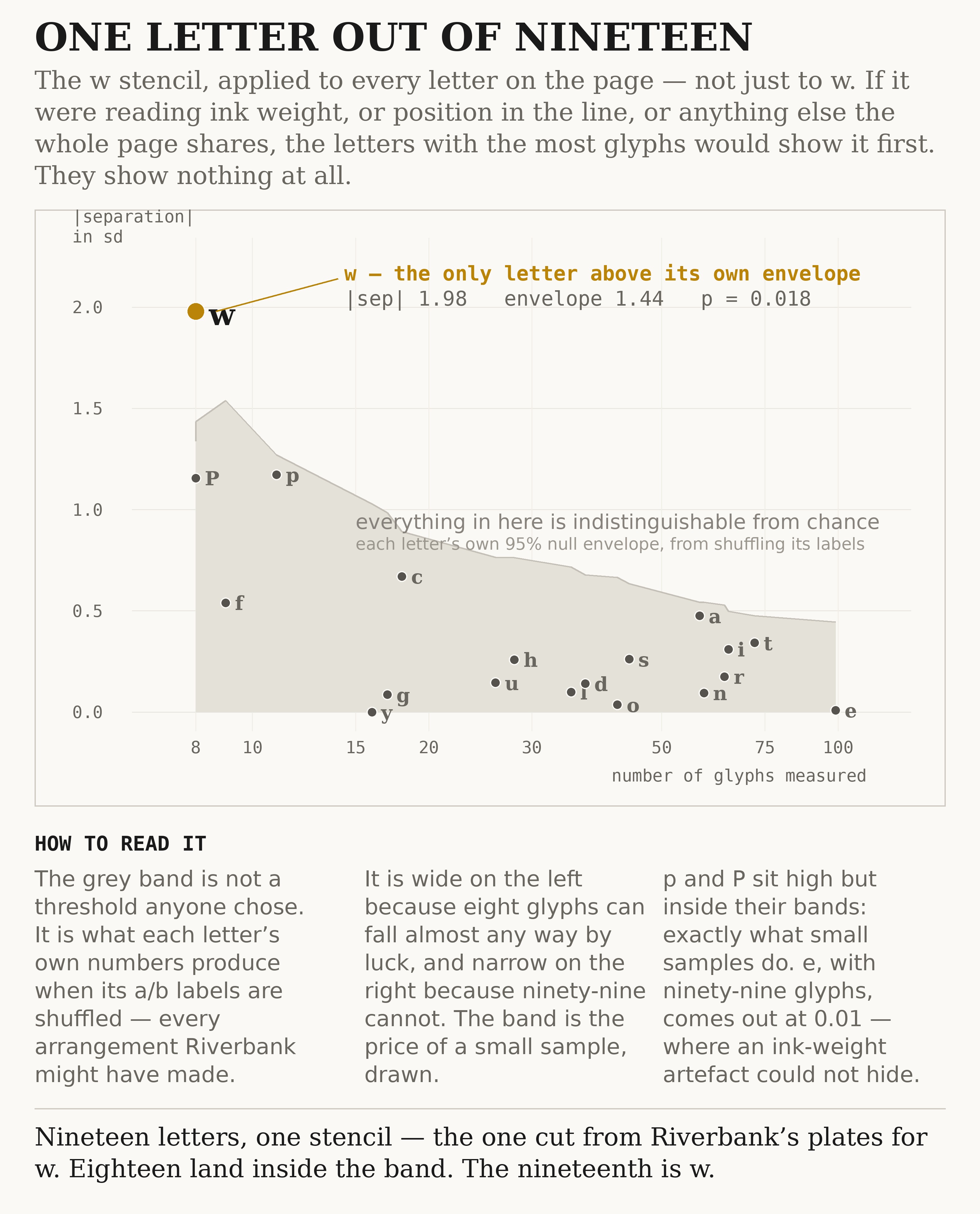
Every measurement so far asked the same question of the same letter. That leaves the obvious objection unanswered: perhaps the stencil is not reading the shape of a w at all, but something the whole page shares — a difference in inking between formes, a drift down the page, a compositor’s habit. Any of those would separate the a-marked glyphs from the b-marked glyphs of any letter, not just of w.
So the w stencil was applied, unchanged, to all nineteen letters on the page with at least three glyphs of each mark — 736 glyphs in all. Each letter was then compared against its own null envelope: the 95th percentile of the separation obtainable by shuffling that letter’s own a/b labels, exhaustively where the sample allows it and over four thousand permutations where it does not. The envelope is wide for eight glyphs and narrow for ninety-nine, which is exactly the point.
letter    n    |sep|   95% env      p
e        99     0.01     0.44   0.969
t        72     0.34     0.47   0.161
i        65     0.31     0.50   0.223
r        64     0.17     0.53   0.535
n        59     0.09     0.54   0.733
a        58     0.47     0.54   0.089
s        44     0.26     0.63   0.424
o        42     0.04     0.67   0.917
d        37     0.14     0.68   0.685
l        35     0.10     0.72   0.800
h        28     0.26     0.76   0.523
u        26     0.14     0.77   0.727
c        18     0.67     0.89   0.200
g        17     0.09     0.98   0.872
y        16     0.00     1.03   1.000
p        11     1.17     1.27   0.091
f         9     0.54     1.54   0.512
P         8     1.16     1.34   0.179
w         8     1.98     1.44   0.018   <- the only letter outside its envelope
This does not enlarge the sample. It is still eight glyphs of one letter, and p = 0.018 remains the floor available at that size. What it removes is the whole family of explanations in which the stencil works for a reason that has nothing to do with the letter w.
⚑ Setting the plates aside altogether
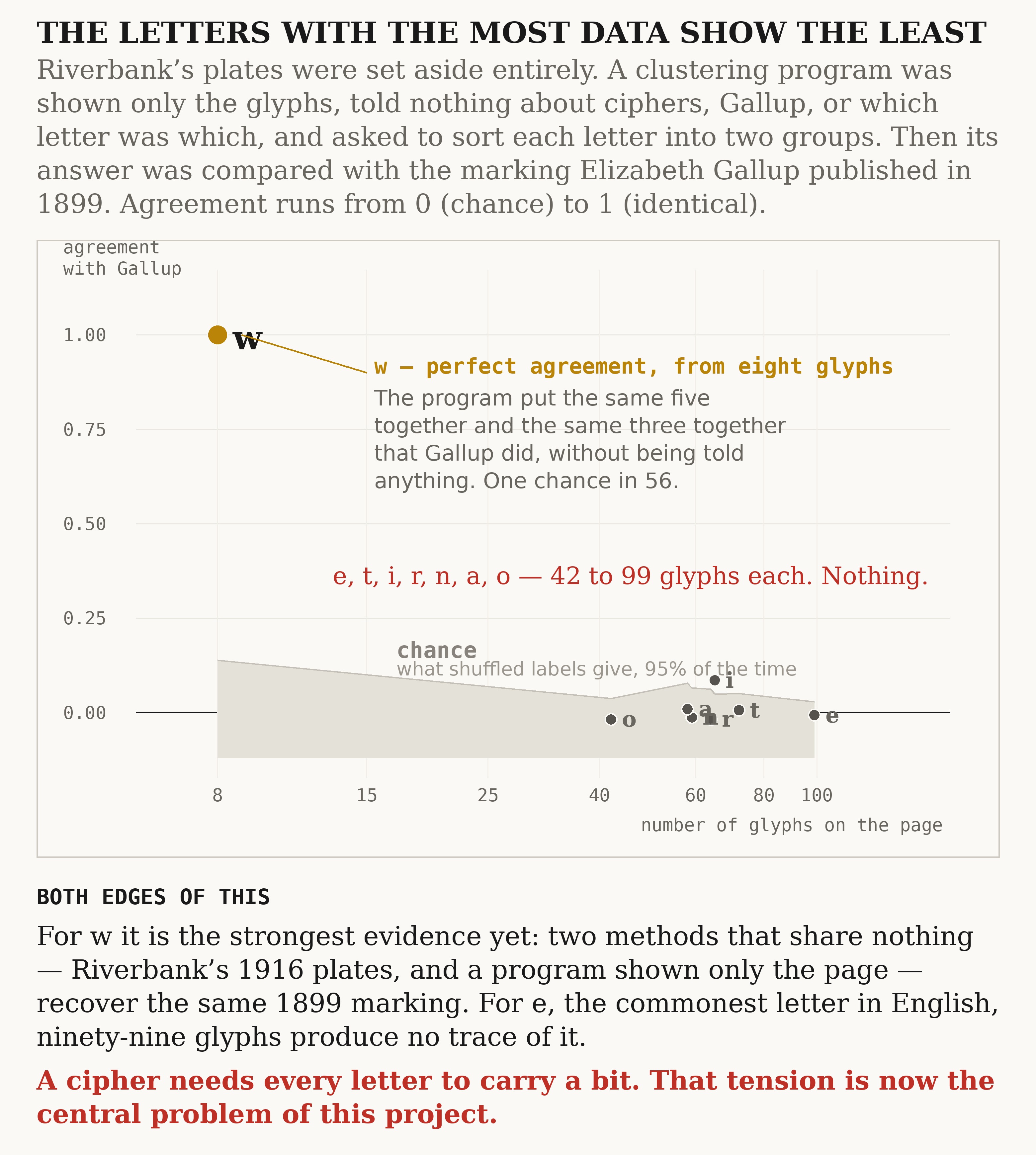
Every test to this point has used Riverbank’s 1916 exemplars in some form. A different question can be asked that uses nothing of theirs: do the glyphs of a given letter, on the page itself, fall into two groups? That is the bibliographical question in its plainest form, and it needs no exemplar, no scale factor and no ground truth.
Each glyph of a letter was normalised for size, registered to that letter’s own average shape by outline ICP, reduced by principal components, and clustered into two groups by a Gaussian mixture. The clustering never sees Gallup’s marking. Only afterwards is its answer compared with hers, by the adjusted Rand index — 0 for chance agreement, 1 for identical. The chance level for each letter was fixed by shuffling that letter’s own labels two thousand times.
letter    n    agreement    chance (95%)
e        99      -0.007          0.028
t        72      +0.006          0.050
i        65      +0.085          0.048
r        64      -0.018          0.062
n        59      -0.013          0.065
a        58      +0.009          0.077
o        42      -0.018          0.037
w         8      +1.000          0.138   <- identical to Gallup
i exceeds its chance level slightly (0.085 against 0.048). With eight letters tested, roughly one such exceedance is expected by luck, and it is recorded here rather than claimed.
⚑ Two stable groups everywhere — and only one of them is the cipher
The clustering above was pressed further. If a letter’s two groups are real rather than an accident of one run, they should survive resampling: cluster sixty bootstrap samples of the same glyphs and count how often each pair of glyphs lands together. A perfectly stable structure gives every pair a co-association of 0 or 1; pure noise gives 0.5 throughout. The index below is 1 for perfect stability and 0 for a coin toss.
letter    n   stability   agreement with Gallup   what the split actually tracks
w         8      1.000            1.000           glyph height          r 0.98
t        72      0.978            0.006           glyph width           r 0.45
r        64      0.931           -0.018           ink density           r 0.62
a        58      0.923            0.009           position down page    r 0.35
n        59      0.895           -0.013           glyph width           r 0.47
e        99      0.853           -0.007           glyph width           r 0.52
o        42      0.796           -0.018           glyph width           r 0.68
i        65      0.587            0.085           glyph width           r 0.76
For w the split tracks glyph height, at a correlation of 0.98 — and glyph height is precisely what Riverbank’s written description says distinguishes the two forms: “first and third strokes on the left extend above the body of the letter”. The physical quantity the clustering seized on is the one the 1916 manual names in words. That is a third independent line arriving at the same place.
Why this differs from every earlier confirmation
The 3 September height measurement, the 5 September shape-similarity matrix and the projection profiles all derived their two forms from the page. A fair critic could answer that a split was found and then named.
Here the two forms come from a book printed in 1916. The stencils, the scale and the registration are all fixed before any Folio ink is measured. And the letter that separates is the one named on 2 September, before any of this machinery existed.
What this does not show
- Eight glyphs. Three of them b-form. That is a small foundation for the only positive result in the file.
- Only six letters had both a usable stencil and enough clean page glyphs, so nothing here is an alphabet-wide claim.
- It does not touch the three-printings problem: Gallup and Fiske worked the Second Folio of 1632, Riverbank the First of 1623, and E. S. Smith the Third of 1664. At most one can be reading type.
- It does not touch the untested cancel pages, and the cancel remains the leading non-cipher explanation.
- Two founts is not a message.
Publication
hosting   GitHub Pages, branch main, served from the repository root
build     none — hand-written HTML, no framework, no generator
DNS       Namecheap BasicDNS · A @ 185.199.108/109/110/111.153 · www CNAME fb-decipherer.github.io.
TLS       Let's Encrypt, issued and renewed automatically
tracking  none — no analytics, no cookies, no third-party scripts
cost      one domain registration a year, and nothing else
Next, in order
- The rest of the cancel — "gg3"v, "gg4"r, "gg4"v. Nobody claims a cipher on any of them. If the split appears there, it is a printing accident.
- Score every letter with a usable stencil across many pages, so the question becomes a histogram rather than a dot plot.
- Gallup's 1913 alphabets against the 1916 descriptions of the same letters. If the stated criteria changed in three years, they were not being read off fixed objects.
Standards this series holds itself to
- Predictions and falsifiers are written down before the data is looked at.
- Only open, re-fetchable data. No privileged access, no unique artefact.
- A determinate procedure. Nothing in today's measurement depends on the practised eye — which is precisely the part of the 1916 method that cannot be audited.
- Negative controls must return null.
- The null gets published in the same terms as a positive.
- Where the work cuts against the claim, it is said here first.