The short version
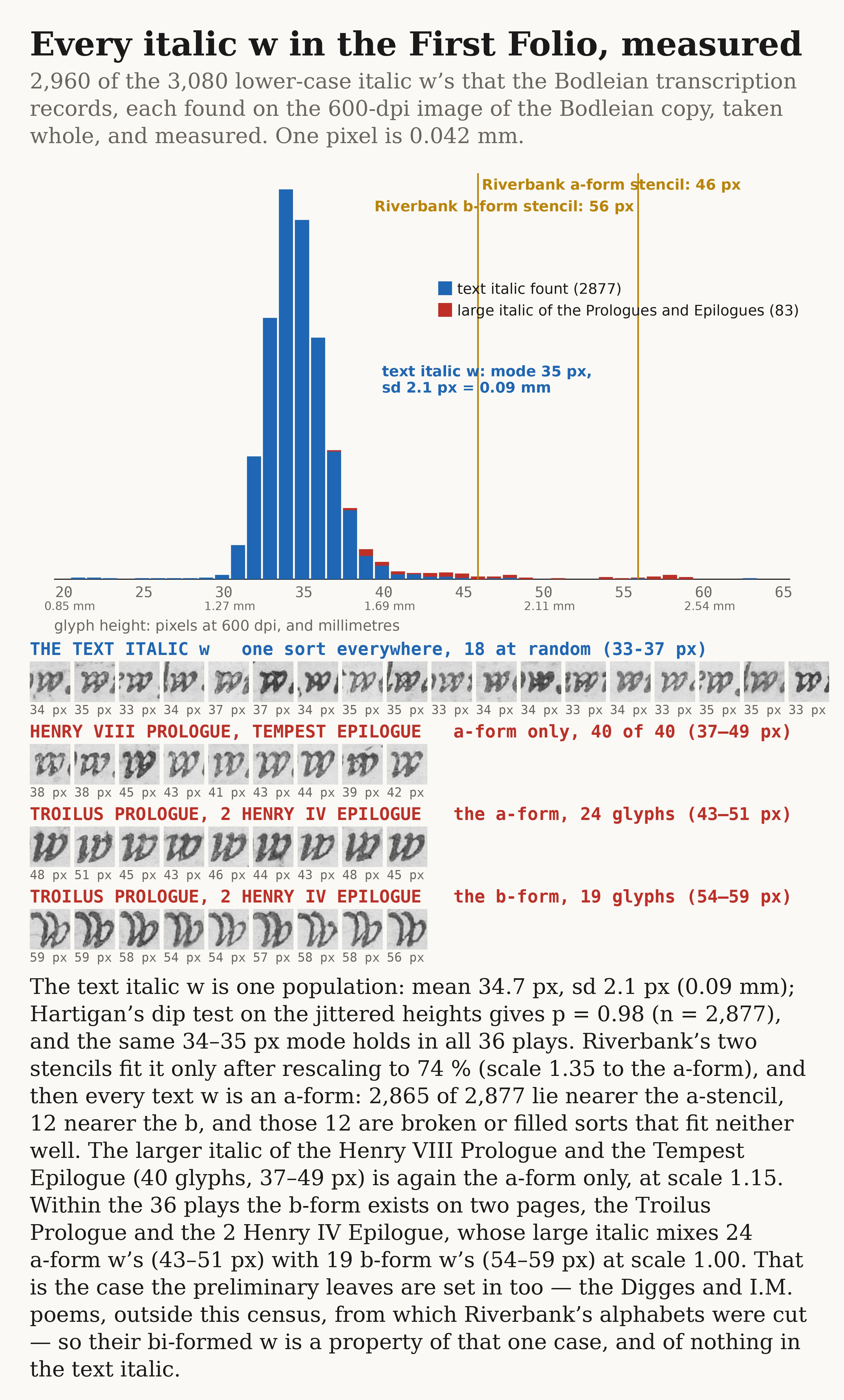
In 1899 Elizabeth Wells Gallup said the First Folio carried a hidden message in the shapes of its italic letters: two founts so alike that no reader notices, alternating to spell a binary code Bacon had described in 1623. Every test this project has run since the second of September has come back the same way — the rules Riverbank published for telling the two founts apart do not hold on the page Riverbank chose — with a single exception. The lower-case w separates, and separates cleanly, on a feature none of their rules names: it comes in two heights.
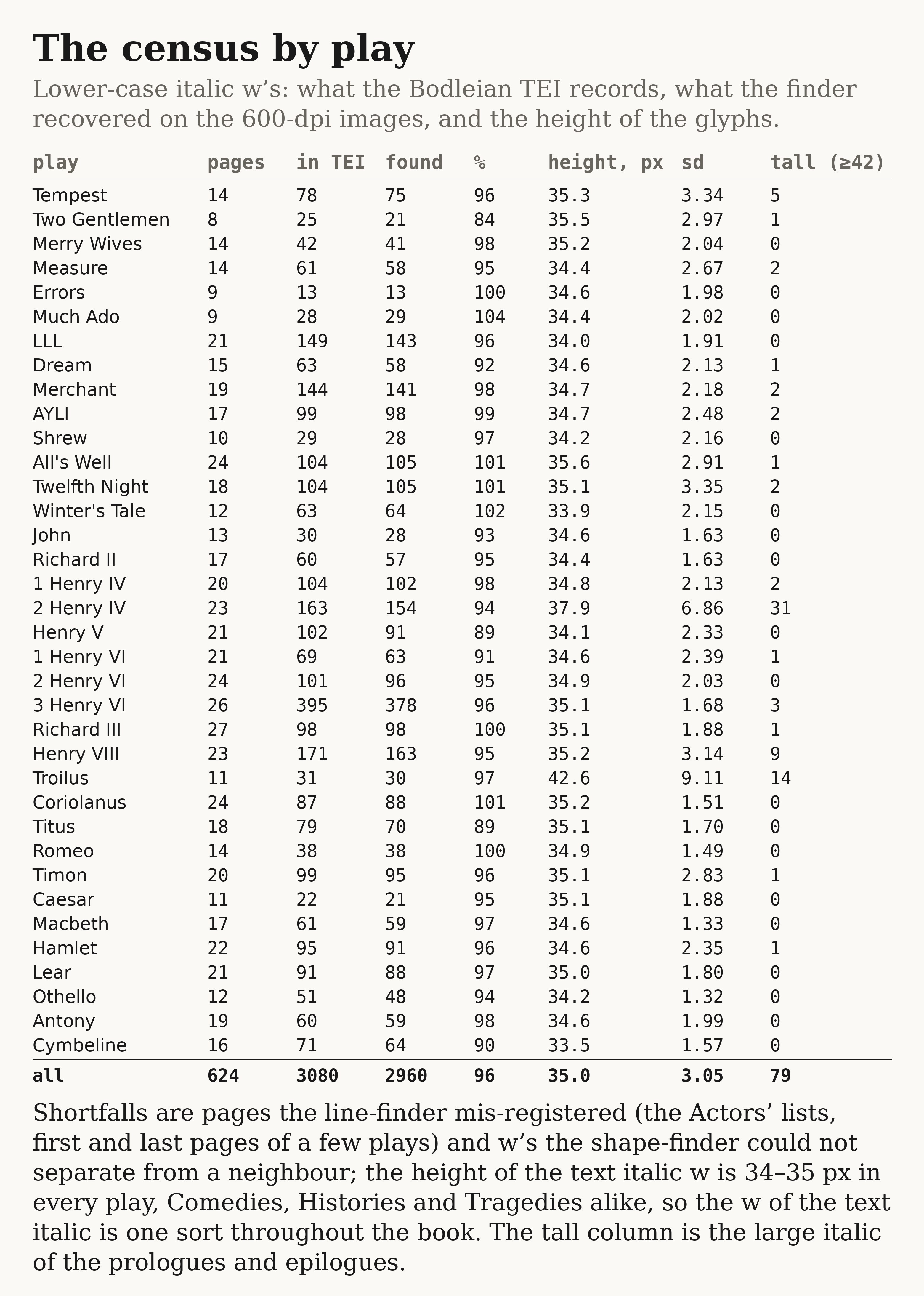
So the w was the letter worth settling, and it could be settled exhaustively. The Bodleian’s transcription of the Folio records every letter of every page and whether it was set in roman or italic. That turns a vague question into a countable one: there are 3,080 lower-case italic w’s in the thirty-six plays, on 624 pages. Over the seventh and eighth of September the project went and found them — not a sample, not an estimate — on the Bodleian’s own 600-dpi photographs, and measured every one against both of the w stencils cut from Riverbank’s 1916 alphabet plates.
Questions
What is the biliteral cipher?
Sir Francis Bacon described it in 1623. Every letter becomes a group of five symbols, each symbol either an a or a b — five binary digits, three hundred years before anyone called them that. AAAAA is A, AAAAB is B, and so on.
The two symbols need not be letters. They can be two founts of type so similar that a reader notices nothing. Print an innocent passage in an alternating mixture of the two, and the passage carries a second message that only someone who can tell the founts apart can read. Bacon called this writing “omnia per omnia” — anything by means of anything.
What was done on these two days, in plain terms?
Every lower-case italic w in the thirty-six plays was found on the photographs and measured. The Bodleian publishes both a machine-readable transcription of the Folio and 600-dpi images of every page, so it is possible to know in advance how many there should be (3,080), to go and locate each one, and to report honestly how many were missed.
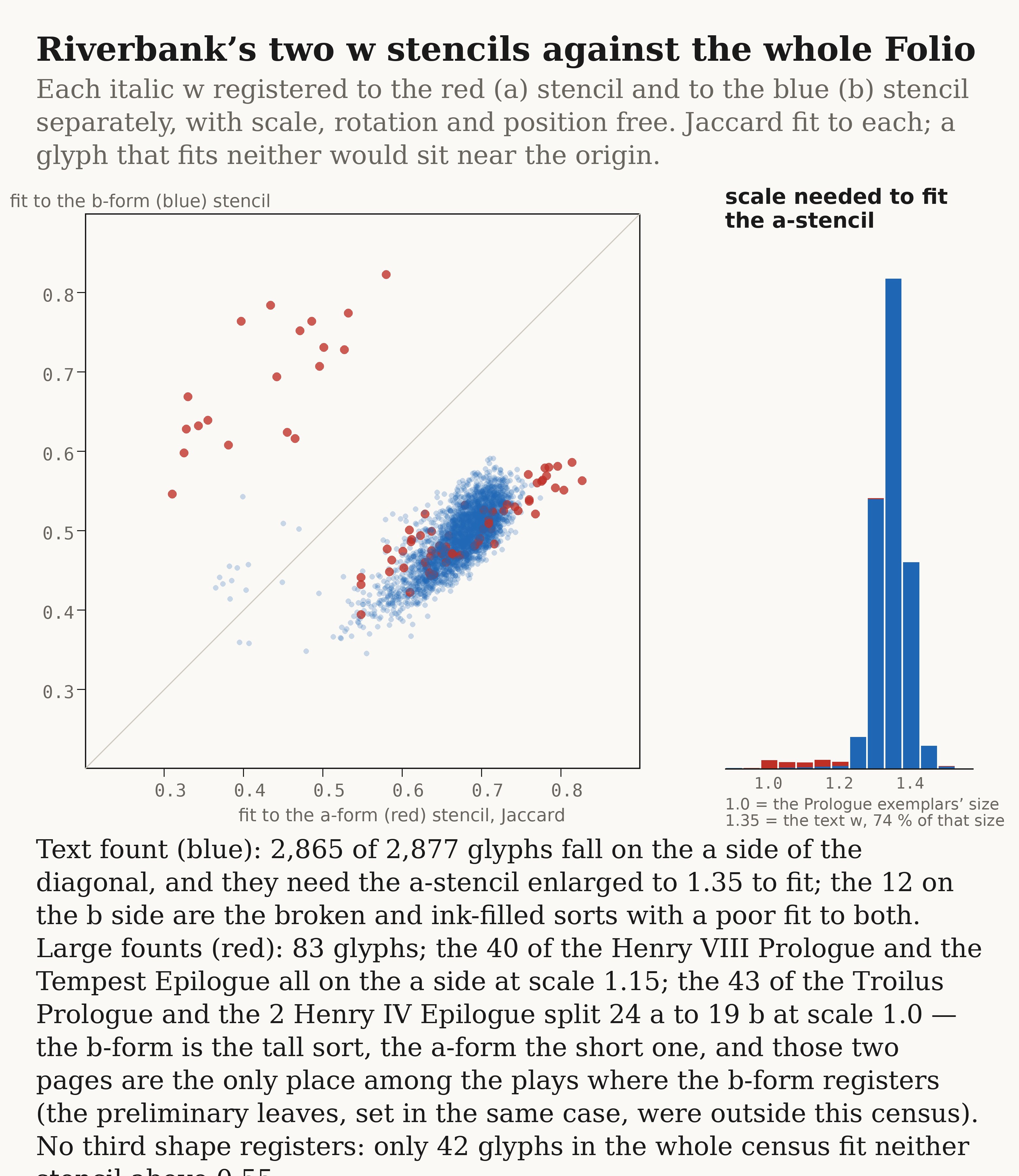
Each glyph found was then registered twice — once against the a-form w stencil and once against the b-form — with size, angle and position all free to move. That is the test Walter asked for in July: not a single number computed from a glyph, but the two shapes laid over it at full resolution, so that a letter belonging to neither would be visible as such.
What did you find?
One w, everywhere. The text italic of the plays uses a single sort: 34.7 px tall on average, spread of about two pixels, and the same peak in all thirty-six plays. Statistically there is no sign of two overlapping populations — the dip test, which asks exactly that question, comes back as negative as it can.
The two forms Riverbank drew are real, but they belong to a different case of type: the larger italic used for four Prologue and Epilogue pages and for the preliminary poems. In that case, and only there, a short w and a tall w sit side by side on the same line.
Does this disprove Gallup’s decipherment?
No, and it is worth being exact about why. This is a census of one letter. Gallup claimed the cipher across many letters and many pages, and a negative result for w in the text italic does not by itself settle the others.
What it does is remove the one piece of positive evidence this project had generated. Since the second of September the w was the sole letter that separated into two groups under measurement. The obvious reading was that it might be the surviving trace of a two-fount setting. The census says otherwise: the separation was real, but it lives on four pages of a different fount, and those are the pages Riverbank’s own exemplars were cut from. The finding is a necessary condition failing, not a message being read.
If there is no second w, what were Riverbank’s two stencils cut from?
From the large italic. Both stencils match that case at its own size — the a-form at scale 1.0, the b-form at scale 1.0 — and they fit the text italic only after being reduced to about three-quarters. A printer’s case that has acquired two w sorts of different height is an ordinary thing; it is what happens when sorts are replenished from another founder’s stock.
That is the whole difficulty with the exemplars, and it was already recorded on 5 September under a different heading. The forms were defined on the pages where the difference exists, and then applied to pages where it does not.
Whose claim is this — Friedman’s or Fabyan’s?
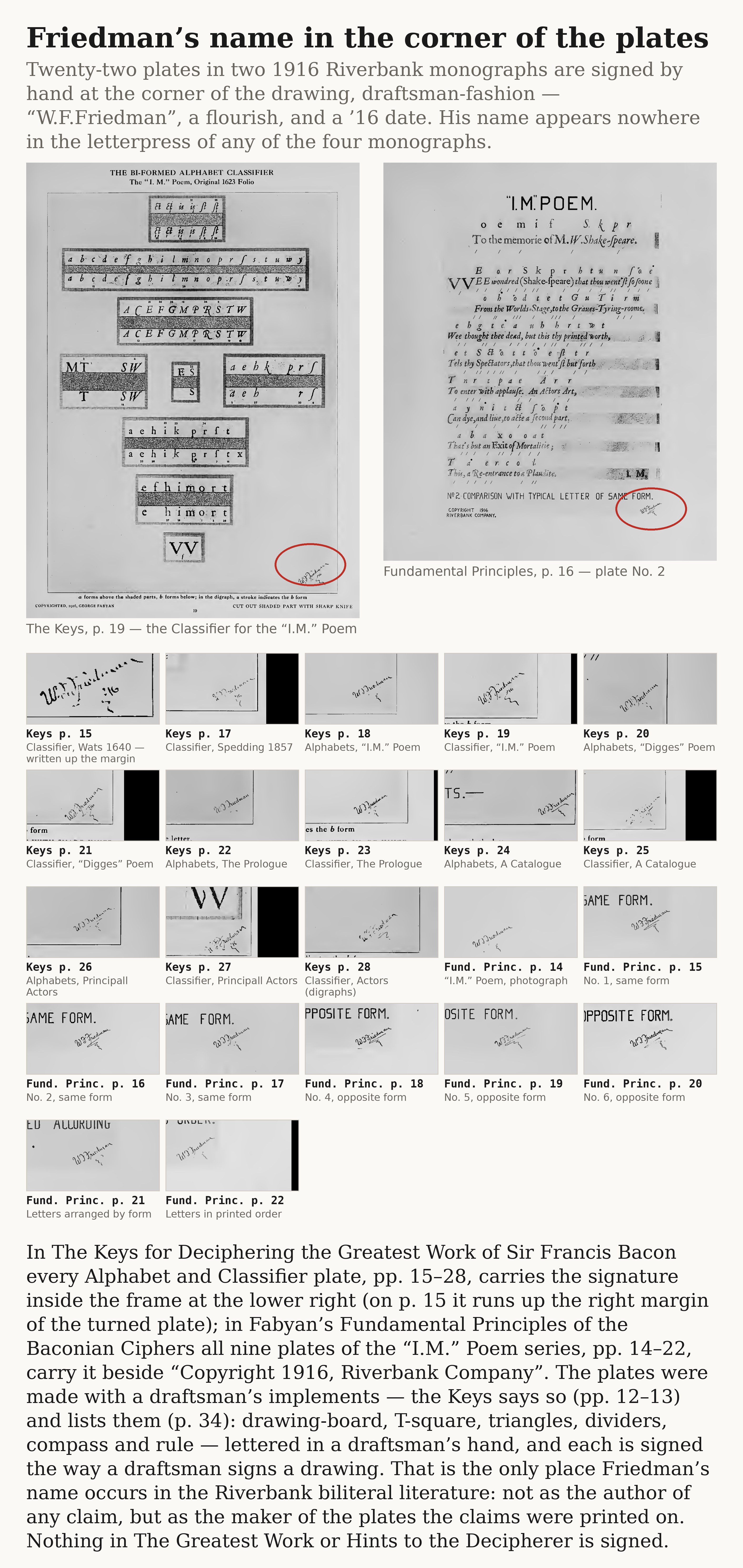
Fabyan’s. William F. Friedman went on to become the most consequential cryptologist the United States has produced, and his name is often attached to the Riverbank biliteral work as though he had vouched for it. He did not. His name occurs in these four booklets in exactly one place: hand-signed, twenty-two times, in the corner of a plate, the way a draughtsman signs a drawing.
The claims are signed by George Fabyan, who owned Riverbank. Friedman drew the alphabets. He later spent much of his life arguing that the Shakespeare ciphers were not there.
Riverbank said a fourteen-year-old could learn to read the cipher. Is that not evidence?
It is evidence of something, but not of the cipher. The passage is in the Foreword to Fundamental Principles of the Baconian Ciphers (1916) — signed Fabyan, not Friedman. It says the principles are “really a simple matter”, that “young people of fourteen years and upwards… note readily differences in type”, and that one student at Riverbank marked 940 letters in three hours with only eight errors. The same page recommends the cipher for kindergarten teaching “in blocks, beads, weaving, or colors”, and for the blind, where it would require learning “two differences… in place of twenty-six”.
Two things follow. The first is that sorting two designed founts is genuinely easy, which nobody disputes — and Fabyan concedes in the very next sentence that the Elizabethan volumes are “a more difficult matter” because there “the two forms of type are not so clearly distinguishable”. The second is the important one: eight errors against what? The student was scored against Riverbank’s own answer. There is no independent key. An exercise like that measures agreement with the house reading, not recovery of a message — which is the same circularity already recorded here for the exemplars, arriving now from the pedagogy side.
The pamphlet that would carry the strong form of this claim, Ciphers for the Little Folks (Riverbank, 1916), is not in hand. Until it is, that part of the record is unexamined, and is listed on the Reference tab as a gap rather than passed over.
What would change your mind?
Stated before the census was run, and unchanged by it: a second w population in the text italic, separated on the images without reference to Gallup’s marks, holding across plays set by different compositors, and decoding to language when read five letters at a time. The census tested the first condition on the whole book and it failed. If the same census on a, e and o — which is next — found two populations where w shows one, that would be a genuine surprise and would be reported as one.
Who is doing this, and why?
Walter Wilkinson, in Worland, Wyoming, working from free public sources: the Bodleian’s images and transcription, Library of Congress scans of the Riverbank booklets, and open-source tools. Nothing here depends on access anyone could withdraw.
The wider project is New Gorhambury, and it includes Experiment One, which argues a conclusion. These reports deliberately do not. They record what was tested, what was found, and what failed, on the day it happened — including, as here, results that cut against the Baconian case.
External documents
Every source relied on, with what it is and where the original lives. All are free and public.
Technical colophon
The whole-Folio census of the lower-case italic w: population, pipeline, arithmetic, and the four per cent that got away. Walter’s brief, set on 6 September, was exact: measure, do not calculate — register each glyph against the red and blue stencils at the scale Gallup worked at, so that a third class could declare itself if one existed.
This issue was produced on 7 and 8 September 2026 from free files: the Bodleian’s image service and its TEI transcription of the First Folio, Library of Congress scans of the Riverbank booklets, and open-source tools. Every figure below can be regenerated from the pipeline described, on any machine, by anyone.
The population, and how it was counted
3,080 lower-case italic w’s on 624 pages, from a physical-line walk of the thirty-six Bodleian TEI files (scripts/census/tei_lines.js). Spans carrying a roman rend are excluded; capitals are excluded. Three encoding quirks had to be handled before the count was trustworthy: duplicated and skipped pb facs values, re-numbered per play; and column-break patterns that vary between leaves — 11, 112, 121, 1212 and 12123 — each of which changes how a physical line maps to a transcribed one.
⚑ The pipeline
1  quarter-scale page   IIIF  full/1353,   639 pages
2  grid                 column and line detection on the quarter page
3  alignment            TEI line ↔ grid line, Needleman–Wunsch on width and
                        italic-fraction features (grid.py); mean match 1.84
4  strips               one 600-dpi strip per w-bearing line, ±1.6 pitches
                        1,705 strips, 270 MB, fetched in Chrome (strip_fetcher.js)
5  component finder     italic bank  8 Prologue + 12 text exemplars
                        roman bank  12, unsupervised harvest
                        + pairs for broken sorts
                        + w-sized windows driven through joined sorts
                        + residual low-threshold scan on short lines (stscore.py)
6  registration         each italic w fitted TWICE — once to stencil A, once to
                        stencil B — scale, rotation and position free (score2)
7  classification       nearest stencil by Jaccard, with a K-means check
                        (census_analysis.py)
8  repair               12 mis-registered pages re-fetched whole, in quadrants
Step 6 is the one that matters. A single scalar computed from a glyph can only ever place it on a line someone chose in advance; two independent registrations place it on a plane, and a shape belonging to neither stencil lands near the origin where it can be seen.
⚑ Yield
found and measured   2,960 of 3,080   96.1 %
pages exact          508
pages short          93   (−147 glyphs)
pages over           23   (+27 glyphs)
⚑ The text italic is one population
mean height     34.7 px at 600 dpi   =  1.47 mm
sd               2.1 px               =  0.09 mm
mode            34–35 px, in every one of the 36 plays
dip test        p ≈ 0.98   (n = 2,877; median of 30 jittered runs, diptest)
nearer a-form   2,865 of 2,877, at scale 1.35
nearer b-form          12  — broken or ink-filled sorts, poor fit to both
fits neither           42 glyphs in the whole census, Jaccard < 0.55
Hartigan’s dip test asks precisely the question at issue — is this one hump or two — and 0.98 is about as far from two as the test can report. The heights are integers, so the test is run on values jittered by ±0.5 px and the median p over thirty draws is quoted. The 1.35 figure says the text w is 74 per cent of the size of the exemplars Riverbank drew; the stencils do not fit the book’s text fount without being shrunk.
⚑ Where two sorts do exist
Troilus Prologue      axc0589  ┐ 83 glyphs, 64 a-form / 19 b-form, scale 1.00
2 Henry IV Epilogue   axc0423  ┘ short sort 43–51 px = a · tall 54–59 px = b
Henry VIII Prologue   axc0561  ┐ a-form only, scale 1.15
Tempest Epilogue      axc0039  ┘
Three sizes of italic, then, and a ladder of scales: 1.00 for the large italic of the Prologues and Epilogues, 1.15 for an intermediate cutting, 1.35 for the text fount of the plays. The b-form registers on two pages out of 624, and those two pages are set in the same case as the preliminary leaves — the Digges and I.M. poems, which lie outside this census and from which Riverbank’s alphabets were cut. The bi-formed w is therefore a property of one case of type. It is not a property of the First Folio.
⚑ The plate signatures, read at 300 dpi
Twenty-two hand signatures, “W.F.Friedman” with a flourish and a small ’16, none of which any machine transcription of these booklets records. Every Alphabet and Classifier plate in The Keys (printed pp. 15–28; on p. 15 the signature runs up the right margin of the turned Wats Classifier) and all nine plates of the I.M. Poem series in Fundamental Principles (pp. 14–22, set beside “Copyright 1916, Riverbank Company”). Each signature differs from the others, which means the plates were signed individually on the originals and then photo-reproduced.
It fits what The Keys says of itself: the Alphabets and Classifiers were mounted with “a set of draftsman’s implements” (pp. 12–13), itemised on p. 34 as drawing-board, T-square, triangles, dividers, compass and rule. Nothing in The Greatest Work or Hints carries a signature; the Templet drawings (Keys, Figs. 1–5) and the Hints figures carry no name at all. In the entire Riverbank biliteral literature, Friedman’s name occurs only as the maker of plates — never as the author of a claim.
⚑ The Foreword passage, located
Walter asked where Riverbank claims success in teaching the bi-formed alphabet to the young. It is in Fundamental Principles of the Baconian Ciphers, in the Foreword — signed George Fabyan — on its last, unnumbered page (the ninth page of the scan). Two sentences carry it:
"The mastering of the principles of the Bi-literal Cipher is really a simple
 matter.  Young people of fourteen years and upwards, it is found, note readily
 differences in type.  One young student in the Riverbank Laboratories marked
 940 letters in three hours with only eight errors."
The paragraph above it recommends the cipher for kindergarten teaching “in blocks, beads, weaving, or colors”, for “the entertainment and education of children, old people, or invalids”, and for the instruction of the blind, where embossed and set vertically it would require “the learning of but two differences or characters in place of twenty-six”.
Two observations, and the second is the one that counts. First, Fabyan himself immediately concedes the limit of the claim: applying the principles to the Elizabethan volumes is “a more difficult matter”, because there “the two forms of type are not so clearly distinguishable as in the examples given by Bacon himself”. What a fourteen-year-old learns quickly is Bacon’s designed specimen alphabet, where the forms were drawn to be told apart. Second: eight errors against what? The score can only have been taken against Riverbank’s own reading of the same text. There is no independent key anywhere in the Riverbank corpus. An exercise scored that way measures agreement with the house answer, not the recovery of a message — the same circularity recorded on 5 September for the exemplars, arriving here from the pedagogy side instead.
Failures, and what is not established
- Four per cent of the population was not found: sorts joined to a neighbour, sorts broken across the line, and a handful of lines the finder mis-registered. The shortfall is reported per play rather than absorbed.
- Heights are Otsu bounding boxes at 600 dpi and carry about ±1 px of their own.
- A roman-shaped w inside italic words is not established. Twenty-nine candidates were examined and every one proved to be a roman w belonging to neighbouring roman text. This was a live hypothesis going in; it did not survive.
- Transfer rates, for anyone repeating this: the Bodleian IIIF endpoint delivers about 120 KB/s to us, the static host about 275 KB/s. Per-play JPEG zips at 2,105 px wide are the faster alternative source.
Data
census_records.json    20,586 candidates: class, h, w, area, stroke width,
                       J, Ji, Jr, jA, sA, jB, sB, page coordinates
census_pages.json      per-page expected / found / delta
census_byplay.json     the by-play table as published
tei-lines2.json        the physical-line walk
align-and-strips.tgz   grids and alignments
figures                the-height-of-every-italic-w · the-two-stencils-on-the-
                       whole-folio · the-census-by-play · friedmans-name-in-the-corner
not in the repo        625 strip mosaics (270 MB) and 639 quarter pages (600 MB)
                       — regenerable from the pipeline above
What this does not show
- That the biliteral cipher is absent from the First Folio. This is a census of one letter, in one fount, and other letters remain to be done.
- That Gallup marked nothing real. On the four large-italic pages the two w sorts are there to be seen, and she saw them.
- That the Prologue leaf is representative of the book. It is demonstrably not — that is the finding.
- Two founts of w is not a message. Even where the two sorts exist, nothing here shows they were set to carry one.
Publication
hosting   GitHub Pages, branch main, served from the repository root
build     none — hand-written HTML, no framework, no generator
DNS       Namecheap BasicDNS · A @ 185.199.108/109/110/111.153 · www CNAME fb-decipherer.github.io.
TLS       Let's Encrypt, issued and renewed automatically
tracking  none — no analytics, no cookies, no third-party scripts
cost      one domain registration a year, and nothing else
Next, in order
- The same whole-Folio census for a, e and o — the letters with the largest populations and the next-best chance of showing two sorts if two exist.
- The Catalogue leaf and the four large-italic passages as populations in their own right, at full resolution.
- The preliminary leaves — Digges, I.M., Jonson — which are set in the case where the two w sorts live and were deliberately outside this census. They are now the most interesting pages in the book.
- Riverbank’s per-passage Classifier plates (Keys, printed pp. 19–27), still unextracted: a second, independent exemplar set for every letter.
- Ciphers for the Little Folks (Riverbank, 1916) — the one monograph in the series still not read, and the one that would carry the strong form of the pedagogy claim.
Standards this series holds itself to
- Predictions and falsifiers are written down before the data is looked at.
- Only open, re-fetchable data. No privileged access, no unique artefact.
- A determinate procedure, with every hand judgement named as such.
- Negative controls must return null.
- The null gets published in the same terms as a positive.
- Where the work cuts against the claim, it is said here first. Where it cuts against this project’s own earlier result, it is said here first too.