The short version
In the 1890s a Detroit physician named Orville Ward Owen claimed that Francis Bacon had hidden a long prose narrative inside the printed works of Shakespeare, Spenser, Marlowe and others — recoverable by collecting every sentence containing certain guide words and reassembling them. To do it he built a machine: two spools in a wooden frame, and between them a thousand feet of canvas with roughly a thousand printed pages pasted to it, so he could wind the whole English Renaissance past his eye and mark it in coloured pencil.
The canvas still exists, in storage in Gardiner, Montana. The frame and the second spool do not. And for the last nine years everyone writing about it — this project included — has been looking at a 300-pixel thumbnail.
Questions
What is the Word Cipher?
A claimed method, not a code in the ordinary sense. Owen's account is that certain common words — fortune, honour, nature, pan and a handful of others — were planted as signposts, and that the sentences containing them, gathered from across many books and sorted into piles by a shared key word, assemble into a continuous secret narrative.
The procedure he describes is physical and mundane. His own words: "pencil around every sentence containing the guide word being used, thus enclosing the keys as well." Then head each sheet with its key word, sort the sheets into piles, and join like to like.
So what changed today?
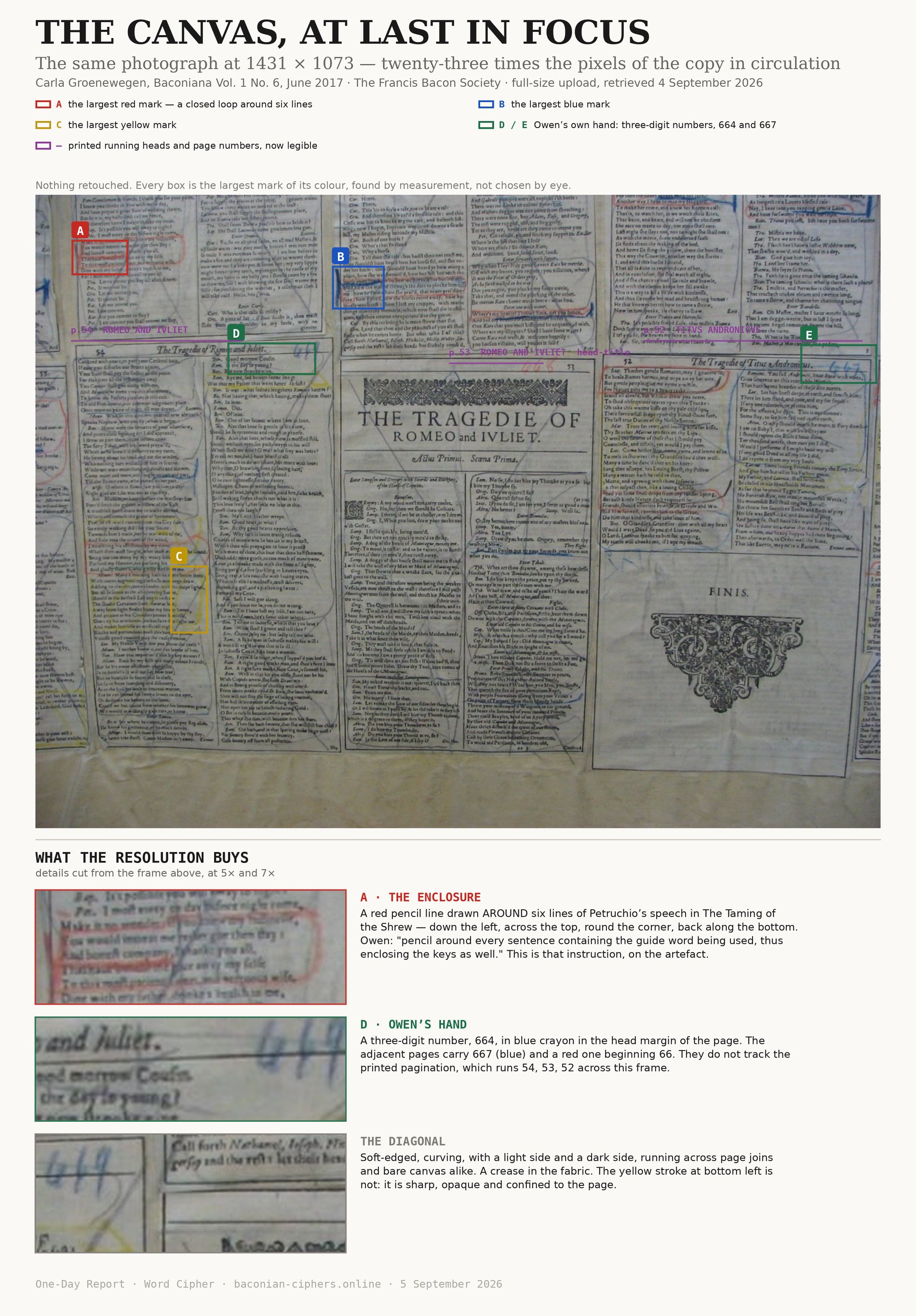
The photograph everybody cites is a WordPress thumbnail — the small copy a website generates automatically from a larger upload. Stripping the size suffix from its address produced the original: 1431 × 1073 instead of 300 × 225, twenty-three times the pixels.
At that size the canvas becomes readable. Three things came out of it.
The marks are enclosures. Detail A is a red pencil line drawn around six lines of Petruchio's speech in The Taming of the Shrew — down the left, across the top, round a rounded corner, back along the bottom. A closed loop around a passage. That is Owen's instruction, executed. Yesterday this report said the question could not be answered at the available resolution. It can now, and the answer is enclosure.
Three colours, not six. Red, yellow and blue separate cleanly. Green does not appear at any threshold. An exhibit sheet prepared here in August said "roughly six colors"; that stays withdrawn, and the corrected figure is three.
Owen's own handwriting is legible. Every pasted page carries a three-digit number in its top margin — 664 and 667 in blue crayon, another in red — and they do not follow the printed page numbers, which run 54, 53, 52 across this frame. What they are is unknown. There are about a thousand of them on the canvas and nobody has ever read one.
And the lines you said were creases?
Still creases. But the argument this report gave yesterday was wrong, and that matters more than the conclusion.
Yesterday's reasoning was: the dominant diagonals carry no colour, therefore they are not pencil. Graphite is grey. A plain pencil line would have passed that test unchallenged. The colour measurement could never have separated a crease from a graphite mark, and saying it did was an error.
What settles it is the full-resolution shape. Detail C shows one: soft-edged, gently curving, with a light side and a dark side, running across pasted-page joins and over bare canvas without deflecting. That is drape in a hanging textile. The yellow stroke beside it is not — it is sharp, opaque and stops at the edge of the page.
Right answer, bad reasoning, corrected here rather than left to be found.
What can you now read on the canvas?
The running heads and page numbers. The lower band of this section runs, left to right: page 54 of Romeo and Juliet, then page 53 with its head-title, then page 52, the last page of Titus Andronicus. The printed pagination descends left to right. Above it is a band of The Taming of the Shrew.
So the canvas carries parallel bands of different stretches of the book, and in this photograph's orientation the pages run against the direction of the text. Owen's own numbers run the other way again.
Does any of this show the cipher is real?
No. It shows that Owen did what he said he did with a pencil. It says nothing about whether the sentences he enclosed contain a message.
Two things would have to follow, and neither is established. First, that the guide words are unusually placed rather than falling where common words fall. Second, that the reassembly is determined rather than chosen — that a second person, given the same key word, produces the same text. There is one report of exactly that test being passed, in 1893, and it is discussed below; it is the best evidence in the file and it is still one man's account of one afternoon.
Is there an eyewitness?
One, and he is unusually good.
Josiah Byram Millett — Harvard graduate, founder of a Boston publishing house — went to Detroit in February 1893 and asked Owen to show him. Owen handed him a key word, Story of the Spanish Armada, showed him the procedure, and left him to it. Millett copied about a hundred lines from various parts of the wheel himself and assembled them, adding no words of his own. Owen had independently written out his own version beforehand. The two were compared and, in Millett's account, corresponded almost exactly.
He went back twice more. In December 1895 he was let into the workshop and spent several hours alone with some two thousand sheets of extracts, satisfying himself they contained passages from the Iliad — a judgment he was equipped to make.
Against it: he was a sympathiser, the conditions were unrecorded, and a method with enough latitude can be taught to produce the expected answer. And the exact issue and date of the article carrying these accounts is still not pinned down, which is stated here rather than glossed.
What would a proper scan settle?
How many colours Owen really used and whether they mean anything. Whether every mark is an enclosure or only some. Which passages he selected, from which editions, in what order — the whole of the method's evidence. And the thousand numbers in his own hand.
This photograph covers roughly eight pasted pages of about a thousand. A rig for the rest exists on paper: a gantry that carries the camera over the canvas rather than moving the canvas, a flattening platen that applies only its own weight, and a lighting spec written for faded pencil on aged fabric. It has never been built, because until today there was nothing to point it at.
The condition is the pressing fact. The glue is drying and pages are crumbling. The canvas can be unwound gently once. Not twice.
What would change your mind?
Stated in advance, as every issue of this series does:
- If a scan shows most marks are underlines rather than enclosures, Owen's description of his own procedure is inaccurate and every reconstruction built on it has to be rebuilt.
- If the guide-word sites turn out no denser at his cited passages than anywhere else in the text, the method is finding what any method would find.
- If the three-digit numbers turn out to be a librarian's or a later owner's, they carry nothing.
The second is testable today without the canvas, and it is next.
Who is doing this and why?
Walter Wilkinson, Worland, Wyoming. This is the sister strand to the Biliteral Cipher work published alongside it.
The reason it has merit is that the artefact is decaying in storage, no one has measured it, and the one photograph everybody cites turned out to be a thumbnail of a better one that was sitting at a public address the whole time.
The wider project lives at New Gorhambury. Worth knowing before you read it: those pages argue a conclusion. These reports deliberately do not.
External documents
Every source relied on, with what it is and where the original lives. All are free and public except where noted.
Technical colophon
Everything below was produced on 4–5 September 2026 from one published photograph. Every step runs offline in seconds and every number can be re-derived from the same file.
⚑ The source, and how the better copy was found
The image in circulation is A-marked-up-section-of-the-canvas-300x225.jpg. That -300x225 is a WordPress size suffix — the small copy a site generates from a larger upload. Removing it returns the original.
circulating copy    300 x 225 px    14,046 bytes
full-size upload   1431 x 1073 px   315,029 bytes    22.7x the pixels
source   Carla Groenewegen, "Dr Orville Owen's Cipher Wheel: Past, Present and Future"
         Baconiana Vol. 1 No. 6, June 2017 · The Francis Bacon Society
address  wp-content/uploads/2017/04/A-marked-up-section-of-the-canvas.jpg
It has been at that address since 2017. The lesson is worth recording: check whether the image you are measuring is a thumbnail of a better one.
Colour is measured against the canvas, not against white
The canvas is aged and yellow, so absolute hue is meaningless. Converted to CIELAB; the paper reference is the median a*, b* of the brightest quartile; every chroma below is distance from that reference, so "coloured" means coloured relative to this canvas. The frame edge and the table beneath are excluded before anything is counted.
paper reference     a* -0.93   b* +2.11
frame chroma        mean C* 3.52   p99 14.59   max 40.12
colours separating  RED 335-45 deg · YELLOW 80-130 · BLUE 245-305
GREEN 130-200 deg   nothing survives at any threshold
Three colours, not six. The August exhibit sheet's "roughly six colors" is withdrawn and replaced by a measured three.
⚑ The marks enclose
The largest red component in the interior sits at x 66–152, y 81–131 — an 86 × 50 px outline whose ink fills a small fraction of its own bounding box, which is the signature of a loop rather than a stroke. At 5× it is unambiguous: a line down the left, across the top, round a rounded corner and back along the bottom, enclosing six lines of type.
The enclosed passage is Petruchio in The Taming of the Shrew III.ii:
    Make it no wonder, ...
    You would intreat me rather goe then stay:
    And honest company, I thanke you all,
    That haue beheld me giue away my selfe
    To this most patient, sweet, and vertuous wife.
    Dine with my father, drinke a health to me,
Against Owen's documented instruction — "pencil around every sentence containing the guide word being used, thus enclosing the keys as well" — this is the instruction, performed, on the object.
⚑ Correction — yesterday's reasoning about the diagonals was wrong
The dominant visual feature of the low-resolution copy is a family of fourteen parallel diagonals at 135°, spanning the frame and crossing pasted-page joins. The 4 September argument was that they carry no excess colour and are therefore not pencil:
                          mean C*   mean L*      n
detected diagonals          2.19      50.4      14
random lines, same angle    2.68      52.1    3366
P(random chroma >= detected) = 0.43
Graphite is achromatic. A grey pencil line would have passed that test. The colour measurement could not have distinguished a crease from a graphite mark, and presenting it as if it had was an error of reasoning, not of arithmetic.
The conclusion survives on different evidence. At full resolution the diagonals are soft-edged, gently curving, with a light side and a dark side, and they run across page joins and bare canvas alike. That is drape. A ruled pencil line does not bend, and the yellow strokes on the same page are sharp, opaque and confined to their page.
The negative control from 4 September stands and is worth keeping: the identical line detector on three crops of unmarked 1623 letterpress, reduced and re-compressed to match, returned 0, 2 and 2 lines against the canvas's 89. The pipeline does not manufacture structure out of dense type.
⚑ Owen's hand, and the layout
Every pasted page carries a three-digit number in its head margin, legible at 7×:
p.54 Romeo and Juliet       664    blue crayon
p.53 Romeo and Juliet       66_    RED, partly cut by the frame
p.52 Titus Andronicus       667    blue crayon
They do not track the printed pagination. What they are — his own sheet sequence, a cross-reference, an index into his notes — is unknown. There are roughly a thousand of them on the canvas and none has been read.
The running heads are now readable, and give the layout for the first time:
lower band, left to right   p.54 Romeo · p.53 Romeo head-title · p.52 Titus Andronicus
                            printed pagination DESCENDING left to right
upper band                  The Taming of the Shrew, III.ii and IV.i
So the canvas carries parallel bands of different stretches of the book, and this band runs against book order in the photograph's orientation.
The artefact
cylinder     36 in diameter x 48 in high
canvas       one continuous strip, 48 in wide
pages        roughly 1,000, cut from old editions, annotated in coloured pencil
condition    the glue is drying; some pages are crumbling. It can never be re-rolled.
missing      the wooden frame and the twin empty spool — the machine itself.
             They have the canvas, not the machine.
provenance   donated by Virginia Fellows; held by The Summit Lighthouse, Gardiner, Montana
coverage     this photograph shows roughly 8 pasted pages of about 1,000
The scanner, and why it is shaped the way it is
The failing glue drives the design. A canvas whose pages are crumbling can be unwound gently once and never re-spooled, so the instrument goes to the artefact and the artefact does not move.
geometry    48 in canvas width, matched by the gantry span
motion      camera traverses on a strut-channel carriage; the canvas stays put
platen      flattening platen applies its own weight only — no clamping, no tension
lighting    raking + diffuse pair, colour-managed, specified for faded pencil on aged fabric
state       CAD complete through bill of materials; STEP files and motion studies exist.
            NOT BUILT.
The eyewitness, and its limits
J. B. Millett (1853–1938), Harvard, founder of the J. B. Millet Company of Boston, visited Owen's Detroit workshop at least three times.
Feb 1893    given the key word "Story of the Spanish Armada", shown the procedure, and
            left to work it himself. Copied about 100 lines from various parts of the
            wheel and assembled them "without adding a word". Owen had independently
            pre-written his own version. "The two copies corresponded almost exactly,
            and the differences proved to be slight errors in copying" — Millett's own.
c.1894-95   second visit, not yet detailed from source.
Dec 1895    admitted to the workshop and left alone for several hours with a pile of some
            2,000 foolscap sheets; satisfied himself they contained passages from the Iliad.
Named, traceable, professionally reputable, and he performed the operation himself. Against that: a sympathiser, unrecorded conditions, and a procedure with enough latitude can be taught to reproduce an expected answer. The exact issue and date of the article carrying these accounts is not yet established.
Publication
hosting   GitHub Pages, branch main, served from the repository root
build     none — hand-written HTML, no framework, no generator
DNS       Namecheap BasicDNS · A @ 185.199.108/109/110/111.153 · www CNAME fb-decipherer.github.io.
TLS       Let's Encrypt, issued and renewed automatically
tracking  none — no analytics, no cookies, no third-party scripts
cost      one domain registration a year, and nothing else
Next, in order
- Test the guide-word structure where it can be tested — in the printed text, no canvas needed. Owen names King John I.1 as the commencement of his entire decoded corpus, and the phrase he quotes is genuinely there. Whether that site is unusually dense in guide words is runnable now.
- Ask the George C. Marshall Foundation, which holds both Friedman collections, whether anything survives of Riverbank's twelve-lesson course. Enquiry drafted.
- Pin the Millett article's issue and date; locate the second-visit account.
Standards this series holds itself to
- Predictions and falsifiers are written down before the data is looked at.
- Only open, re-fetchable data. No privileged access, no unique artefact.
- A determinate procedure. Every box on today's figure is the largest mark of its colour, found by measurement, not chosen by eye.
- Negative controls must return null.
- The null gets published in the same terms as a positive.
- Where the work cuts against the claim — or against this project's own reasoning of the day before — it is said here first.